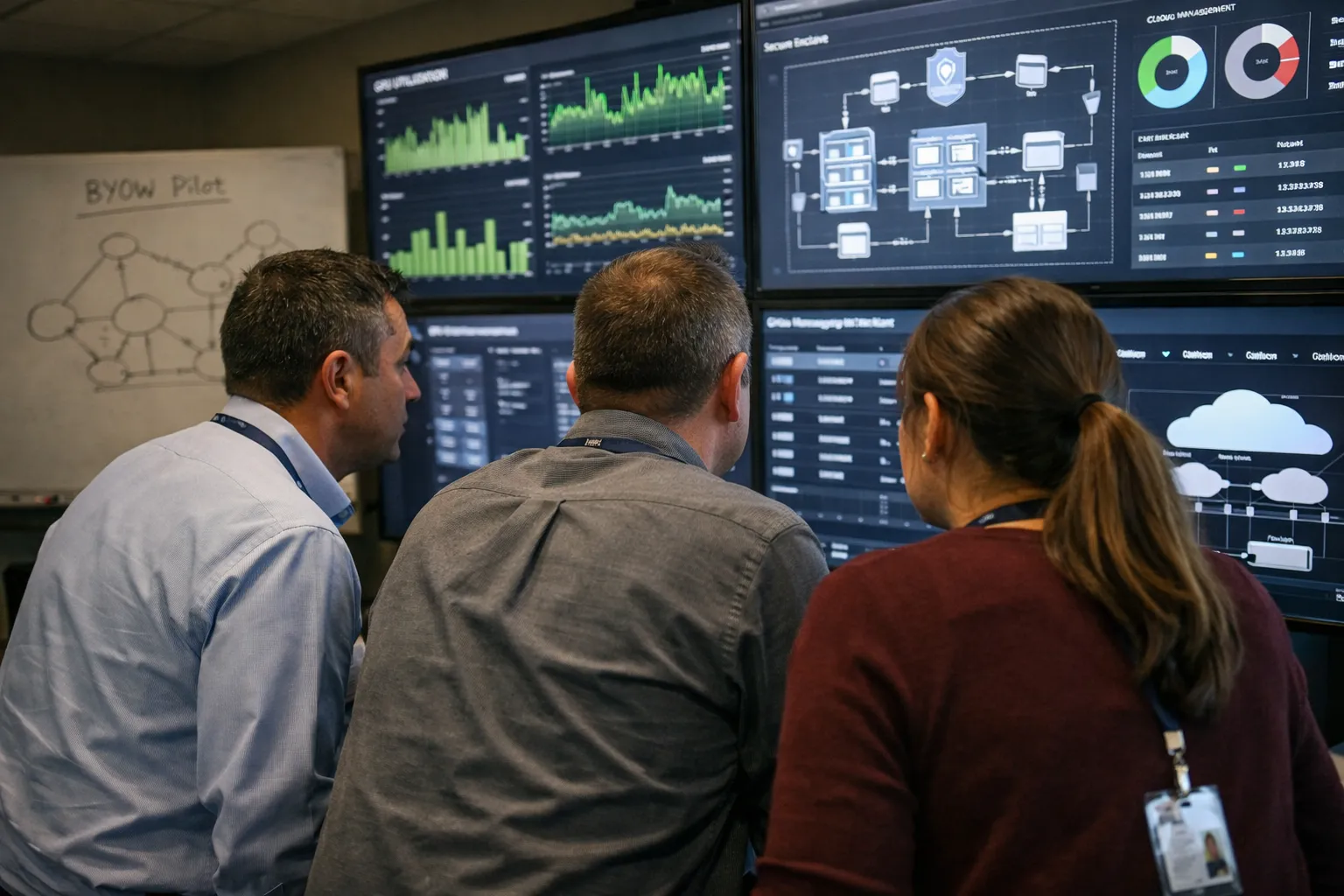
Who, what, when, where, why: As of June 2026, enterprise AI teams and major cloud providers are continuing the shift from hosted, multi-tenant model endpoints to bring‑your‑own‑weights (BYOW) private inference running in confidential compute and tightly controlled network perimeters. Organizations in regulated finance, healthcare, telecom and retail are adopting BYOW to lower long‑term inference costs, retain custody of sensitive data and produce attestation evidence required by auditors and regulators.
Context: why this matters now
The core BYOW proposition remains unchanged since this topic first gained traction: load pre‑trained or fine‑tuned model weights into a runtime that isolates execution from the model-hosting vendor and other tenants. What changed in 2025–mid‑2026 is breadth and maturity. Cloud vendors, chipmakers and open-source runtimes have converged on practical stacks that combine GPU acceleration, confidential compute protections and enterprise orchestration—so private inference is no longer an experimental corner case for only the largest firms.
Why it matters: enterprises now see BYOW as an operational lever that affects budgets, vendor negotiations and compliance posture. Where hosted APIs once dominated prototyping, production deployments increasingly treat hosted endpoints as a low-volume fallback while sustained inference workloads move into private fleets.
What changed since March 2026
- Confidential compute for accelerated inference is more available. Major cloud providers and chip vendors have extended confidential compute support to GPU and accelerator instances, enabling execution with memory encryption and attestation hooks. That includes industry-standard attestation protocols and integrations with cloud key management systems so customers can retain key custody.
- Enterprise orchestration and autoscaling matured. Tooling for autoscaling GPU inference clusters, model lifecycle CI/CD for weights, and standardized observability (request tracing, per‑model telemetry and audit logs) are now offered as managed services or community reference stacks.
- Marketplace and certification programs evolved. Several cloud marketplaces and partner programs now provide certified model artifacts with metadata for licensing, provenance and performance benchmarks, easing procurement reviews and reducing legal friction.
Real-world examples and signals
By mid‑2026, customer case studies in banking and healthcare—where data residency and auditability are determinative—show production BYOW deployments for high‑volume tasks such as call‑center summarization, KYC automation and clinical‑document extraction. Procurement teams report that, for continuous high‑throughput workloads, private inference on reserved GPU capacity commonly repays the migration and operational overhead within months versus hosted APIs, though the exact break‑even depends on utilization, model size and latency requirements.
Enterprise drivers: cost, control, compliance (updated)
Cost remains central. Hosted API pricing models (per‑token or per‑request) create ongoing variable spend that is hard to predict at scale. BYOW lets organizations convert variable costs into capitalized or reserved operational spend that can be optimized via scheduling, model quantization and batching. Vendors and customers consistently cite a range of cost improvements—commonly 2×–10× lower per‑inference cost for sustained, high‑volume workloads—depending on utilization and hardware choices.
Control and compliance pressures have intensified. Regulators and auditors increasingly request cryptographic attestation of model execution and evidence of key custody. Enterprises now demand standardized attestation artifacts and immutable logging for model inputs, outputs and telemetry to support incident investigations and regulatory filings.
How vendors and the ecosystem are responding
Vendors have moved from prototype features to productized capabilities:
- Confidential runtimes with GPU support: cloud providers and independent platform vendors now surface runtimes that combine memory encryption (hardware-backed) with integrated key management and attestation APIs.
- Managed orchestration and reference architectures: turnkey stacks that tie model registry, CI/CD for weights, autoscaling clusters and observability are available from both hyperscalers and specialized platforms.
- Certified model programs: marketplaces increasingly offer read‑only model artifacts with provenance metadata, licensing terms baked in and performance benchmarks to speed procurement and reduce IP exposure.
Remaining frictions: licensing, IP and operational burden
BYOW does not remove complexity. Commercial model licenses still frequently constrain deployments (for example, prohibiting certain uses or requiring royalties), and open‑source models vary widely in licensing terms. Legal teams must reconcile license terms with intended private deployments. Operationally, enterprises shoulder responsibility for patching runtimes, securing GPU fleets, managing keys and monitoring model drift—capabilities many organizations are still building out.
AI governance and security implications
Operational custody is forcing better model lifecycle practices. Firms deploying BYOW tend to implement:
- Model registries with signed artifacts and provenance metadata;
- CI/CD pipelines for weights and inference code, including canary deployments and rollback paths;
- Telemetry and anomaly detection to surface drift, data‑leakage risks, or adversarial behavior;
- HSM-backed key custody and stringent egress controls to limit data exfiltration risk.
Security teams gain stronger perimeter and cryptographic controls but inherit new responsibilities: securing accelerators, managing attestation policies, and proving execution fidelity to auditors.
Operational patterns we see in the field (June 2026)
- Hybrid control plane: orchestration and governance in cloud control planes; inference execution inside confidential compute or on‑prem accelerators.
- Cost‑tiering: sustained high‑volume inference moves to BYOW private fleets; ad hoc, low‑volume or experimental workloads remain on hosted endpoints.
- Model sandboxing and certified artifacts: read‑only model deliveries and attestation reports speed procurement while protecting vendor IP.
What CIOs and AI leaders should do now (practical checklist)
- Inventory and economics: catalog models, inference volumes, latency needs and license terms. Calculate utilization thresholds where BYOW is cost‑effective.
- Pilot in a production‑like setting: run a 3–6 month confidential‑compute pilot that measures latency, availability, security controls and TCO, and produces attestation artifacts for compliance teams.
- Strengthen governance: update model governance to include custody, patching cadence, telemetry, incident response and attestation retention policies.
- Negotiate forward‑looking licenses: push vendors and model providers for enterprise‑grade licensing that covers private deployments, auditability and attestation support.
- Build runbooks: codify operational playbooks for model rollout, rollback, key compromise, and periodic re‑validation of attestation evidence.
Impact: who is affected and how
Enterprises with predictable, high‑volume inference needs—call centers, fraud detection, insurance claims processing—stand to save materially. Regulated industries benefit from clearer compliance evidence. Smaller teams and rapid innovators will still use hosted endpoints for prototyping. Overall, BYOW changes procurement dynamics: vendors must offer clearer licensing and attestation support, and buyers must invest in ops and security.
Reactions and vendor positioning
Platform vendors pitch simplified BYOW adoption—managed confidential runtimes, certified model catalogs and attestation APIs—while independent security and observability vendors emphasize the need for telemetry and runtime integrity. Legal and procurement teams increasingly require model provenance metadata and contractual attestation deliverables as a condition of procurement.
What's next: timelines and signals to watch
- Watch for standardized attestation artifacts and marketplace metadata becoming procurement prerequisites across regulated sectors over the next 6–12 months.
- Expect continued consolidation of orchestration and observability features into managed stacks—look for cross‑cloud reference architectures and tooling that reduce integration overhead.
- Monitor licensing evolution: expect more enterprise‑friendly, deployment‑agnostic licensing options from major model vendors in response to buyer pressure.
Frequently asked questions
Is BYOW always cheaper than hosted APIs?
No. BYOW typically becomes cost‑effective when inference is sustained and high‑volume because you amortize reserved compute and optimize batching, quantization and scheduling. For unpredictable, low‑volume or experimental workloads, hosted APIs often remain cheaper and faster to deploy.
Does confidential compute eliminate regulatory risk?
No. Confidential compute reduces the risk surface by protecting memory and keys and providing attestation, but you still need to manage data residency, lineage, licensing and telemetry. Regulators and auditors expect documented controls, not just technology.
How should procurement teams handle model licensing?
Treat licensing as a first‑class procurement item. Require clear, machine‑readable metadata about permitted deployments, audit rights, and royalty terms. Negotiate support for attestation artifacts and model provenance guarantees as part of enterprise agreements.
What’s the minimum pilot scope to validate BYOW?
Run a production‑like pilot for 3–6 months that uses representative traffic, measures latency and cost, produces attestation logs, and exercises incident response procedures. Include legal, security and compliance reviewers to validate artifacts and processes.