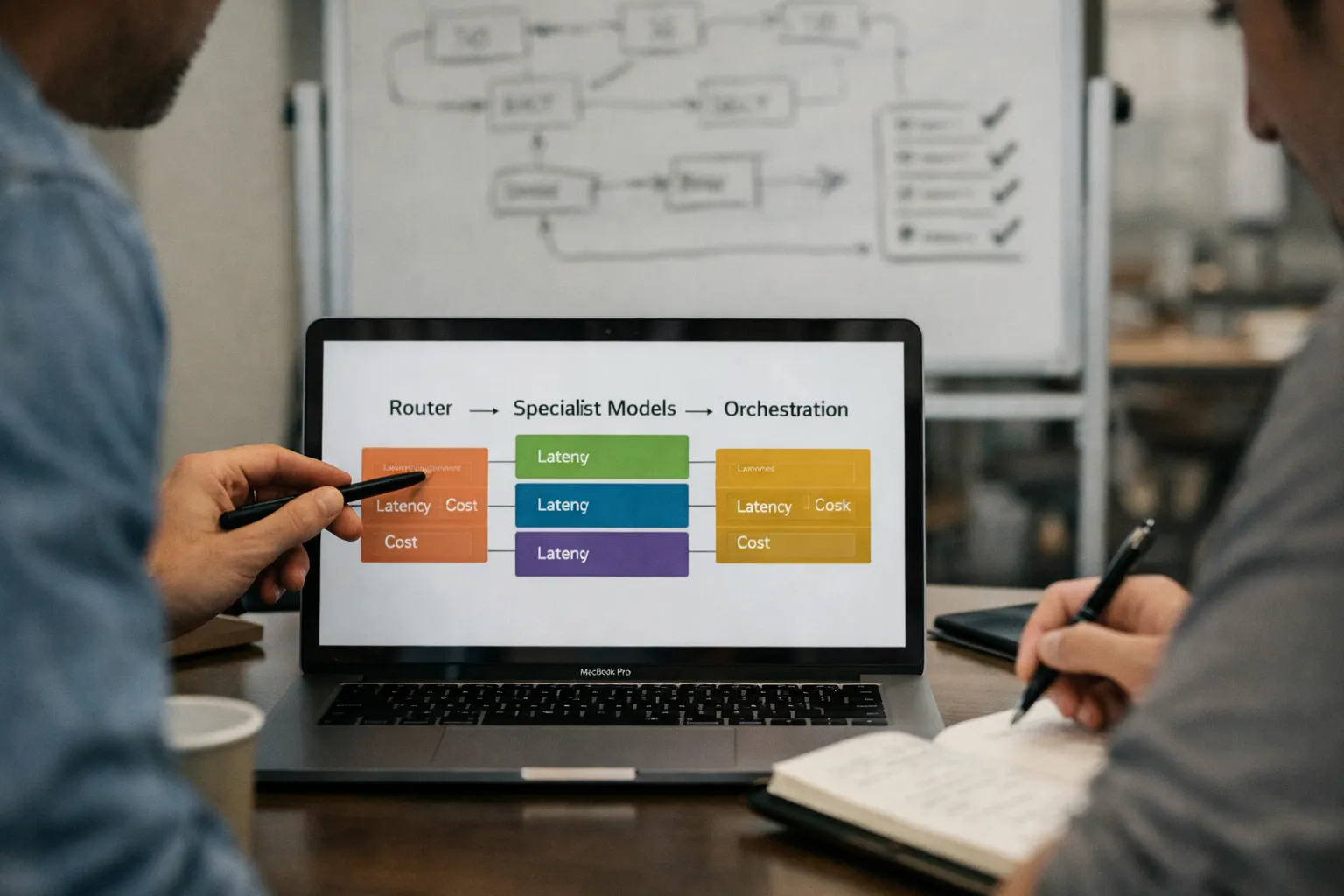
Enterprises in 2026 increasingly choose specialist large language models (LLMs) — legal, finance, code, medical, or vision-enabled models — because they outperform general-purpose models on narrow tasks and compliance needs. But specialist models bring fragmentation: higher per-call costs, inconsistent output formats, variable latency, and operational complexity. Router-driven orchestration — a lightweight model or classifier that directs each query to the best specialist — is the practical pattern that balances accuracy, cost and compliance.
This guide shows AI teams how to design, train, deploy and operate a router + specialist LLM architecture for production enterprise workflows. It focuses on concrete steps, decision points and metrics you can implement today to reduce risk and improve business outcomes.
When to use a router + specialist architecture
Choose this architecture when you need at least two of the following:
- Domain-level accuracy: specialist models demonstrably outperform general models on categories (contracts, clinical notes, code).
- Regulatory or compliance isolation: model outputs must be traceable to a model trained on approved corpora or certified for a regulatory domain.
- Cost or latency optimization: an always-on large multimodal model is too expensive or slow to use for all queries.
- Distinct utility models: you want a dedicated model for structured extraction and another for freeform summarization.
High-level architecture
At a high level the stack has four layers:
- Client/API layer — receives user/query context and enforces authentication, quotas and request shaping.
- Router layer — a lightweight classifier/LLM that assigns each request to one or more specialist models and returns routing metadata and confidence.
- Specialist layer — a set of models (on-prem, private cloud, or SaaS) each optimized for a skill (e.g., "contract-extract-v1", "financial-summarizer-v2").
- Orchestration/obs layer — logging, auditing, tracing, fallback handlers, caching and business-logic post-processing.
Design decisions at each layer determine cost, latency, resilience and compliance outcomes. The remainder of this guide walks through a practical implementation plan.
Step 1 — Define skills and success criteria
Start with a crisp inventory of skills (the “specialists”). Each skill should be a small, clearly scoped capability:
- Entity extraction: financial-entities-from-10K
- Contract clause classification: contract-clause-type
- Summarization: executive-summary-3para
- Code generation: internal-api-client-stub
For each skill define measurable success metrics (examples):
- Precision / recall for extractors (target: ≥90% precision at production threshold)
- Top-1 routing accuracy (target: ≥95% on a holdout set)
- End-to-end user satisfaction or task success (e.g., downstream adjudication time)
- Latency and cost SLOs (e.g., p95 latency 500 ms for synchronous flows)
Step 2 — Collect and label routing data
Routers are only as good as their labels. Collect representative requests and label them with the correct skill(s).
- Start with historical logs (with PII redaction) — map resolved actions (which team/service handled the request) to skill labels.
- Create synthetic edge-case examples to cover ambiguous queries (e.g., “review this contract for liability and extract deadlines”).
- Include negative samples: noisy, out-of-domain, or adversarial text.
- Label multi-intent queries with multiple skills and annotate priority or required sequencing.
Ensure your dataset includes metadata like request length, presence of attachments, user role and compliance flags (PII, classified, etc.).
Step 3 — Choose a router model design
There are three practical router patterns; choose based on latency, maintainability and data availability:
- Lightweight classifier — a supervised model (logistic regression, tree ensemble, or small transformer) trained on labeled routing data. Pros: low latency/cost, easy to deploy on-prem. Use when labels are abundant and skills are stable.
- Embedding-based similarity router — compute embeddings for both queries and skill exemplars; route to the nearest skill centroid. Pros: robust to label sparsity and simpler to extend. Cons: may underperform on fine-grained distinctions.
- LLM-as-router — a small instruction-following LLM (few-shot) that makes routing decisions. Pros: flexible and good for nuanced context. Cons: higher cost/latency; requires careful prompt engineering and observability.
Recommendation: start with a lightweight classifier for production-critical paths and use embedding-based or LLM routers for exploratory or human-in-the-loop channels.
Step 4 — Implement routing logic and safety gates
Routing should not be a simple single-call decision. Implement layered logic:
- Primary routing: the router’s top recommendation and confidence score.
- Thresholds and fallbacks: if confidence threshold, route to a generalist model or human queue; for PII/regulated inputs, force a compliance-approved specialist regardless of confidence.
- Multi-skill routing: if router predicts multiple skills, either fan-out in parallel (if latency/budget allow) or chain skills deterministically (e.g., extract → classify → summarize).
- Timeouts and circuit breakers: if a specialist is slow or errors repeatedly, circuit-break to backup model or degrade gracefully to cached responses.
Step 5 — Normalize interfaces and response contracts
Specialist outputs must be normalized so downstream systems and auditors can rely on stable fields. Define a standard response schema for each skill, including:
- Output fields and types (strings, enums, confidence scores, spans with offsets)
- Model id and version
- Routing metadata (router id, confidence, decision rationale)
- Provenance and data lineage tokens for compliance
Enforce schema validation at the orchestration layer; reject or flag responses that don't match the contract.
Step 6 — Observability, auditing and data retention
Operationaling a router architecture requires rich telemetry:
- Request-level logs: request, router decision, specialist chosen, latencies, costs, response schema validation result.
- Ground-truth collection: capture final human-corrected outputs (when available) to retrain router and specialists.
- Model performance dashboards: routing precision/recall, fallback rate, per-skill latency, cost per successful request, and user satisfaction.
- Audit trail: immutable records mapping each final response back to the specialist model and router decision for compliance teams.
Retention policies should be aligned with legal and privacy constraints; avoid storing raw PII without explicit justification and controls.
Step 7 — Evaluation and gating
Adopt a phased evaluation strategy:
- Offline evaluation — measure top-1/top-k routing accuracy and end-to-end simulated task accuracy on holdout data.
- Shadow testing — run the router in parallel with current production routing, compare decisions and outcomes without affecting users.
- Canary rollout — route a small percentage (1–5%) of live traffic through the new router with strict alerts and human overrides.
- Full rollout with staged scaling — progressively increase traffic while monitoring metrics and rollback triggers.
Define clear gating thresholds (for example: routing precision >95% and fallback rate 3% on canary) before proceeding to the next stage.
Step 8 — Cost, latency and scaling trade-offs
Key trade-offs:
- Latency vs accuracy — routing to the best specialist often improves accuracy but increases end-to-end latency. Use parallelization only when latency budget allows.
- Cost vs quality — specialists are more expensive per token. A good router reduces mean cost by sending only the queries that need specialists.
- Complexity vs maintainability — many specialists require robust CI/CD for model updates and versioning; limit the number of skills to what you can operationally maintain.
Practical tips:
- Cache frequent queries and specialist outputs where appropriate.
- Batch non-interactive requests and process asynchronously.
- Use smaller, cheaper specialist variants for routine sub-tasks and route higher-cost specialists only when necessary.
Common failure modes and mitigations
- Router drift: distributional changes cause routing errors. Mitigation: continuous label collection, periodic retraining and automatic drift detection.
- Overfitting to historical labels: router learns organizational quirks rather than intent. Mitigation: diversify training data, include edge cases, and validate with human-in-the-loop checks.
- Output heterogeneity: different specialists return inconsistent formats. Mitigation: strict response contracts and schema validation at the orchestration layer.
- Compliance gaps: unauthorized data routed to non-approved models. Mitigation: enforce policy gates that override routing based on data classification flags.
Operational playbook and rollout checklist
Before sending traffic to your router, complete this checklist:
- Skills and success metrics defined and documented.
- Representative labeled routing dataset with edge cases.
- Router model trained and validated offline; baseline achieved.
- Fallback/threshold rules and human override workflows implemented.
- Schema contracts and validation implemented for all specialists.
- Observability pipelines, dashboards, and alerting configured.
- Canary rollout plan with rollback triggers and stakeholders notified.
- Compliance review completed for data residency, logging and retention policies.
Case example: contract intake workflow (example)
Imagine a legal ops team that receives contract PDFs and needs clause extraction, risk scoring and executive summaries. A router-based design might:
- Client uploads contract metadata and file; client API strips PII where required and flags the contract as “sensitive.”
- Router classifies request as “contract-extract + risk-score + summarization” with confidences.
- System fans out extraction and scoring calls to specialized models in parallel; summarization uses a specialist tied to approved corpora.
- Orchestration layer normalizes outputs (extracted clauses with offsets, risk-score enum, 3-paragraph summary), validates schema and produces a composite report for legal review.
- Human reviewer corrects outputs; corrections feed back into retraining pipelines for both router and specialists.
Conclusion: incrementalism wins
Router-driven orchestration is a practical way to get the best of specialist LLMs without overwhelming operations or budgets. The pattern is not “big bang” — it rewards incremental rollout, rigorous labeling, and tight schema contracts. Start small: choose one high-value workflow, define a minimal set of skills, and iterate using shadow testing and canaries. Over time the router becomes an operational control plane that improves accuracy, cost-effectiveness and compliance for enterprise AI.
Technical teams that implement this pattern carefully — with clear metrics, robust observability and compliance guardrails — will find they can combine the precision of specialist models with the resilience and manageability required for production enterprise systems in 2026.