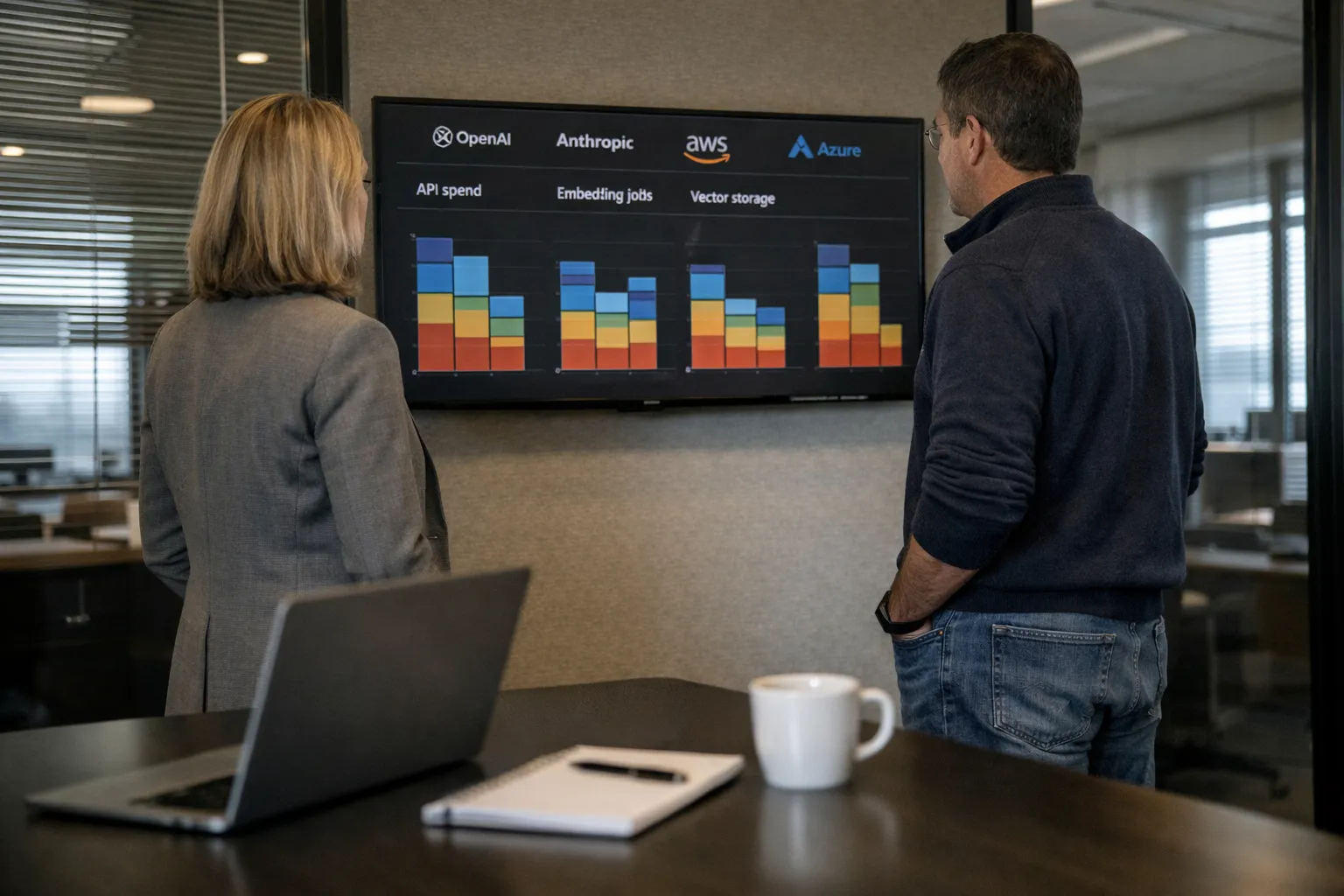
In 2026 the economics of enterprise AI purchasing look very different from 2023–24. Public and private model vendors, cloud providers and third‑party platform vendors have converged on a palette of pricing primitives — consumption (token/compute), committed discounts, enterprise flat‑fee licenses, and line‑item add‑ons for long context, embeddings, vector DBs and private endpoints. For mid‑market and enterprise buyers, the choice between consumption and subscription models is no longer binary: it’s a portfolio decision with measurable effects on ROI, budget volatility and vendor lock‑in.
Why pricing matters more than ever
Three market shifts in 2026 have amplified the importance of pricing structure for AI projects:
- Context and memory costs are real: Many production LLM applications rely on long context windows, session state, or persistent retrieval — each inflates inference compute and token volume compared with single‑prompt queries.
- Retrieval and embeddings are a non‑trivial share of spend: Vector search, index maintenance, and re‑embedding are now regular operational costs rather than one‑time expenses.
- Model choice and specialization: Enterprises increasingly mix general LLMs and smaller specialist models; pricing differences among model families (large generalist vs smaller fine‑tuned) change marginal cost per query.
Breaking down the components of AI TCO (total cost of ownership)
To evaluate pricing models you must itemize the components buyers actually pay for:
- Inference compute / token fees: The variable cost per call (or per 1K tokens) — dominant in consumption models.
- Embedding and vector costs: One‑time vs recurring re‑embedding for updated corpora, plus vector DB storage and compute for search/retrieval.
- Storage and data egress: Long‑term storage of conversational logs, indexed vectors, and model artifacts; cross‑region egress fees can be material.
- Operational monitoring and MLOps: Observability, hallucination detection, retraining, and SRE time — usually charged as professional services or included in premium plans.
- Compliance and private hosting: Private endpoints, dedicated instances, enterprise VPC connectors and certifications introduce line‑item premiums.
- Engineering and integration: The human capital cost of prompt engineering, RAG pipelines, API integration and vendor management.
Consumption vs subscription: strengths and hidden trade‑offs
Both pricing styles work — but for different use cases and buyer risk profiles.
Consumption (pay‑as‑you‑go)
- Benefits: Low upfront cost, elasticity for bursty workloads, and alignment of spend with usage. Ideal for startups or pilot projects where usage is uncertain.
- Risks: Unpredictable monthly bills, exposure to token inflation from longer contexts, and surface‑level cost comparisons that omit embedding and retrieval charges. Without engineering controls, cost can spike when models or context sizes expand.
- Controls: Rate‑limiting, engineered prompts to reduce tokens, cheaper specialist models for routine queries, and embedding caching.
Subscription / committed contracts
- Benefits: Predictable spend, volume discounts (committed use), and often better enterprise SLAs, private instance options and support. Favorable for predictable, high‑volume applications.
- Risks: Vendor lock‑in and overcommitment: if usage doesn’t materialize, the organization can be stuck with sunk costs. Subscriptions sometimes exclude incremental embedding reprocessing fees or vector DB charges.
- Controls: Multi‑vendor clauses, flexible headroom tiers, and built‑in breakpoints for renegotiation.
How hidden cost drivers reshape ROI
Enterprises that compare headline inference rates often miss three repeatable encumbrances that move ROI by 20–50% in practical deployments:
- Index churn: Frequently changing corpora (sales collateral, contracts, regulatory updates) force re‑embedding and index rebuilds. Buyers should quantify expected re‑embedding cadence and include those costs in TCO models.
- Session state and context retention: Personalization that preserves multi‑turn state increases token volume across sessions; storage and retrieval latency trade‑offs also require more expensive hosting tiers.
- Monitoring and safety tooling: Observability stacks, audit logging, and human review workflows add steady operational costs. These are often left to engineering teams and not surfaced in vendor ROI claims.
Realistic procurement approaches — four patterns
In practice procurement teams converge on one of four buying patterns — each balances volatility, discounting, and lock‑in differently:
- Lean consumption with strict FinOps: Low commitment, fine‑grained quotas, and centralized cost monitoring. Best for exploratory projects and regulated pilots; requires strong engineering cost controls.
- Committed core + consumption tail: Buy a committed block for predictable baseline traffic (with a discounted rate) and pay as you go for spikes. This hybrid is the default for many medium enterprises in 2026.
- Enterprise flat license: Fixed annual fee for broad internal use, often bundled with private hosting and SLAs. Good for organizations prioritizing predictability and compliance; watch for excluded add‑ons like vector maintenance.
- BYOM (bring your own model) hosting: Enterprises host models on cloud VMs or on‑prem. This reduces per‑token vendor fees but increases fixed cloud compute, specialist ops staffing and model refresh costs.
Vendor lock‑in: more than just APIs
Lock‑in in 2026 is multidimensional:
- Data format and embeddings: Different vendors use different embedding dimensions and distance metrics. Portability requires transformation pipelines and re‑embedding costs.
- Index formats and orchestration: Proprietary index APIs and agent orchestration flows tie logic to vendor platforms unless abstracted into neutral layers.
- Commercial ties: Long‑term committed contracts can have exit penalties and make switching uneconomic even if a cheaper model emerges.
Mitigation tactics include standardizing on open index formats (where possible), storing raw sources and prompts in vendor‑agnostic repositories, and negotiating data export clauses with realistic SLAs.
Decision framework and checklist for 2026 buyers
Procurement and engineering should evaluate pricing choices across five axes. Use this checklist to structure vendor comparisons:
- Predictability required? Match subscription to steady workloads; consumption to exploratory or unpredictable loads.
- Embedding cadence? Estimate frequency of re‑indexing and quantify its cost.
- Compliance needs? Private endpoints, region guarantees and audit logs often push buyers toward enterprise tiers.
- Vendor portability? Assess embedding formats, export SLAs and the cost to rehost models.
- Operational overhead? Include MLOps, monitoring and prompt engineering FTE costs in ROI models.
Practical example (illustrative)
Consider a mid‑market SaaS firm running a customer support assistant with expected steady traffic of ~250k requests/month and heavy long‑context sessions. Three procurement choices show different outcomes:
- Pure consumption: Lower initial cost but higher month‑to‑month variance and potential cost spikes when context or usage grows. Engineering must enforce quotas and invest in prompt compression to avoid runaway bills.
- Committed core + consumption: Predictable baseline pricing with headroom for growth. Usually minimizes cost volatility and is preferred when traffic is stable and growth is forecastable.
- Flat enterprise license: Highest predictability and operational simplicity. Often the cheapest per‑request cost for intensive, high‑context workloads — but requires negotiating exit flexibility to avoid lock‑in risk if usage declines.
Which is right depends on growth certainty, compliance needs and appetite for vendor consolidation.
Recommendations for finance, procurement and engineering
- Run scenario TCOs: Model conservative, likely and stretch usage scenarios including re‑embedding, vector DB ops and monitoring costs for 12–36 months.
- Negotiate hybrid contracts: Seek committed blocks with a transparent overage rate and escape clauses tied to performance or pricing shifts.
- Standardize exportable artifacts: Store raw documents, prompts and metadata in neutral storage so rehost costs are limited to re‑embedding and compute.
- Implement FinOps controls: Quotas, budget alerts, and staged rollouts to prevent surprise bills during model or context changes.
- Benchmark models by use case: Compare cheaper specialized models for routine tasks and reserve large generalist models for complex queries.
Conclusion
Pricing in 2026 is not just a negotiation over cents per 1K tokens; it’s a strategic lever that affects engineering behavior, product design and vendor relationships. Savvy buyers treat pricing as part of architecture: quantify embedding churn, model selection, and operational overhead; favor flexible hybrid contracts; and build portability into data and index layers to keep switching costs manageable. The right pricing mix — consumption where elasticity matters, committed where predictability drives scale — will be a key determinant of AI ROI in the next three years.