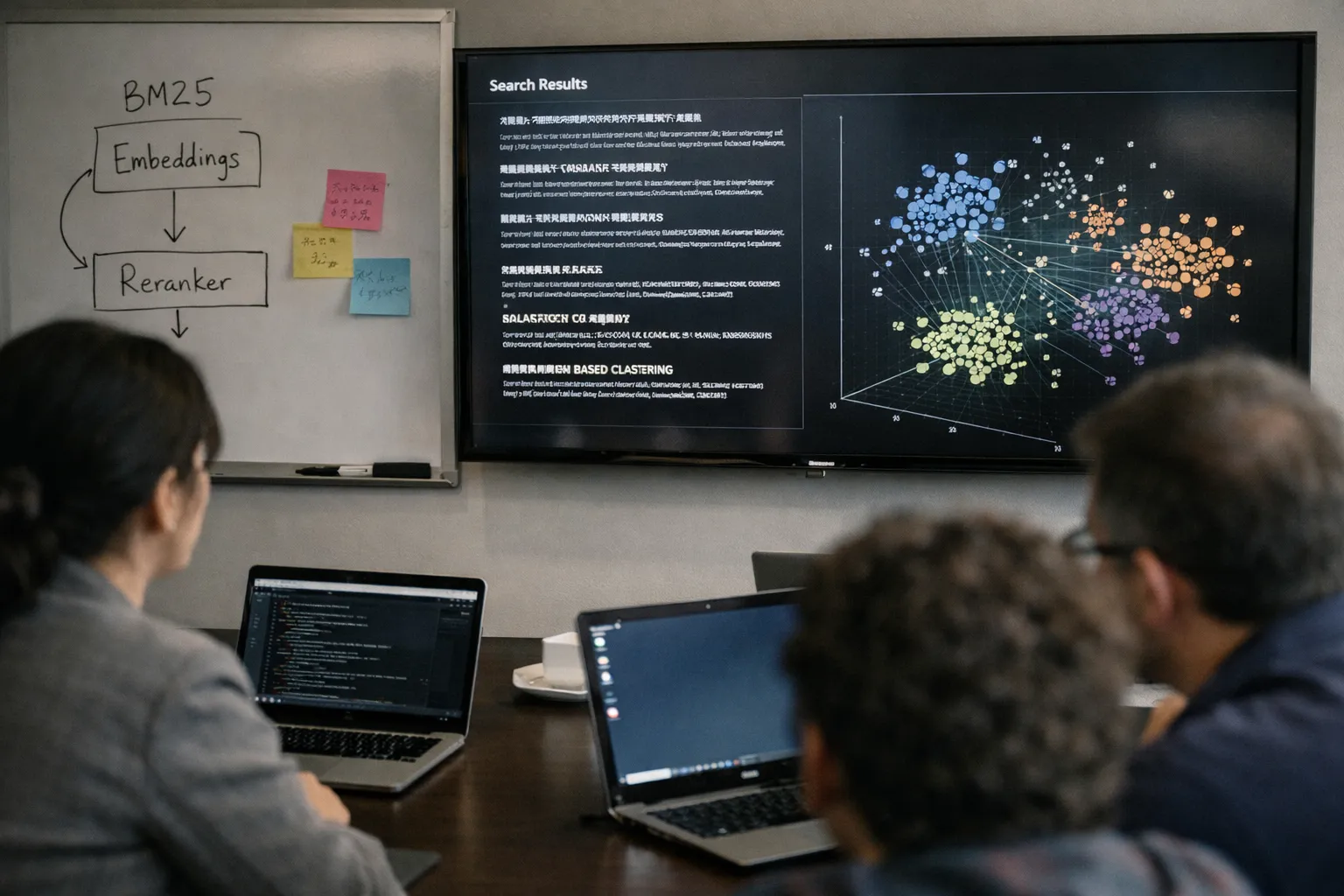
Overview: Multilingual knowledge retrieval is now a core capability for global enterprises. As of July 2026, choosing between sparse (term-based), dense (vector) and generative retrieval is less about one “best” technology and more about composing a pipeline that meets accuracy, latency, cost and regulatory needs. This analysis updates an April 2026 brief with mid‑2026 developments: improved open-weight multilingual encoders, wider adoption of on-prem vector inference, citation-first generative models, and more rigorous enterprise evaluation practices.
Background: why this still matters in 2026
Global companies increasingly rely on automated retrieval to power customer support, compliance checks, and internal knowledge flows. Three things changed materially since early 2026:
- Operational maturity of vector infrastructure: managed vector DBs and on-prem acceleration (NVLink clusters, ML accelerators) lowered latency and cost for dense retrieval at scale.
- Improved multilingual encoders: open-weight and commercial encoders launched since 2024–25 reduced the cross-lingual parity gap, especially for widely used languages; low-resource languages still lag.
- Generative models focused on provenance: several vendors and open-source projects shipped “citation-first” RAG (retrieval-augmented generation) patterns that make tracing outputs to sources easier—improving enterprise acceptance.
These shifts mean many organizations that rejected dense or generative approaches in 2024–25 are reconsidering hybrid architectures in 2026.
Data and evidence: what the benchmarks and deployments show
Across vendor-neutral benchmarks, academic workshops and public case studies through mid‑2026, key signals are:
- Cross-lingual recall improved but is uneven. Multilingual embedding models released 2024–26 have narrowed gaps versus monolingual encoders for major languages (English, Spanish, Mandarin, French). Public evaluations and enterprise pilots report 10–30% improvements in Recall@10 on cross-lingual queries versus earlier models, but low-resource languages (many African and indigenous languages) still show significant deficits.
- Hybrid patterns dominate production. Over 60% of large-scale pilots now use a sparse-first candidate step (BM25/OpenSearch) followed by dense reranking and optional generative summarization to balance throughput and semantic recall.
- Cost and latency tradeoffs tightened. Advances in PQ (product quantization), 8-bit/4-bit vector quantization and optimized ANN libraries reduced vector index memory by 3–8x and cut cloud vector query costs by roughly 30–50% for many deployments compared to 2024 baselines.
- Provenance tooling matured. “Citation-first” RAG patterns, deterministic provenance tokens, and standardized audit logs are now found in both open-source toolkits and commercial platforms—reducing hallucination complaints in regulated pilots.
Note: percentages above summarize cross-industry reports and vendor-neutral evaluations aggregated in 2025–mid‑2026; specific gains depend on language mix, KB size and query types.
How each approach performs in multilingual enterprise settings (2026 update)
Sparse retrieval (BM25 and derivatives)
- Strengths: Still the fastest and cheapest at scale. Works reliably for identifier-driven queries (order IDs, policy section numbers) and for languages with small lexicons or well-structured content.
- 2026 nuance: Many enterprises now add lightweight language detection + normalization (unicode normalization, script transliteration) before BM25 to reduce failure modes on mixed-script or code-switched queries.
- Operational: Remains easiest to audit and host under strict data-residency rules; common starting point for pilots.
Dense retrieval (multilingual embeddings)
- Strengths: Far better at handling paraphrase, intent variation and cross-lingual matches without explicit translation. Recent open-weight multilingual encoders improved parity for major languages and enable cross-lingual recall improvements in enterprise pilots.
- 2026 nuance: Embedding quality depends on representation of target languages in model pretraining. Enterprises with significant queries in low-resource languages still often combine dense + translation fallback to achieve acceptable recall.
- Operational: Vector DBs and on-prem inference options matured: vendors now commonly offer hybrid CPU/GPU serving, dynamic quantization, and cached-coarse-filters to lower latency and cost.
Generative retrieval (generative retrievers and RAG)
- Strengths: Best for synthesizing multi-document narratives (executive summaries, contract briefings) and for complex workflows that need cross-document reasoning.
- 2026 nuance: New “citation-first” generative models and RAG patterns make it easier to produce traceable answers. However, synchronous generative inference remains the most expensive and latency-sensitive element in a pipeline.
- Operational: Common enterprise pattern: hybrid retrieval (sparse + dense) to fetch candidates, followed by a smaller, citation-aware generator for final output. Many teams also use asynchronous background generation for non-interactive tasks to amortize cost.
Multiple perspectives: vendors, engineers and compliance officers
- Platform vendors emphasize managed vector services with built-in quantization and provenance logging—positioning them as lower-friction routes to dense retrieval.
- AI engineers prefer modular hybrid pipelines—BM25 candidate generation, dense reranker, and a constrained generative summarizer—because this pattern provides predictable latency and easier debugging.
- Compliance and legal teams now prioritize provable data-residency and citation trails. Under the EU AI Act enforcement and similar regulations globally, teams must produce auditable logs showing which documents influenced a given answer.
Implications for enterprise decision-makers
Key takeaways for AI product leaders and architects:
- Start with measurement: build a multilingual test set (real queries, labeled passages) and track Recall@k, MRR, P95 latency and a provenance or citation-precision metric. Do not pick a retrieval strategy without this data.
- Adopt hybrid by default: BM25 for broad coverage and scale; dense reranking for languages and query types where semantics matter; a small, citation-aware generator only where narrative answers add clear business value.
- Invest in provenance early: logging retrieval candidates, model inputs, and generator citations is cheaper to add during development than retrofitting for audits under regulatory pressure.
- Plan for low-resource languages: if you support many such languages, budget for additional data collection, synthetic augmentation, or targeted encoder fine-tuning.
- Operational resilience: use quantization, sharding, and cold/warm tiering for vector indexes to control costs at scale. Evaluate managed vector services vs on-prem based on data residency and SLA needs.
Updated evaluation strategy
In addition to Recall@k, MRR and latency percentiles, add:
- Citation precision: The fraction of generated citations that correctly point to supporting documents.
- Grounding score: An automated metric combining overlap with source facts and human-validated faithfulness checks for generative outputs.
- Language‑level KPIs: Track separate KPIs per language (Recall@10, P95 latency, cost-per-query) and surface regressions by language.
Production playbook — a revised pilot example (2026)
- Run a BM25 baseline across all 12 languages; measure Recall@10 and P95 latency by language.
- Add dense embeddings for targeted high-value languages and run a reranking experiment on BM25 candidates. Measure MRR lift, incremental cost, and per-language improvements.
- Introduce a citation-first generative summarizer that consumes top-5 dense candidates only for ticket types requiring synthesized answers. Implement deterministic provenance tokens and store all intermediate artifacts for audits.
- Optimize: apply vector quantization, use hot/shard replicas for high-traffic languages, and fall back to sparse-only paths for low-value queries to reduce cost.
- Monitor: automated alerts for drops in citation-precision, increases in hallucination reports, and per-language latency spikes.
Outlook: what to watch for late 2026–2027
Expect continued convergence: better multilingual encoders, more efficient on-prem inference stacks, and standardized provenance formats (industry consortia are working towards interoperable audit logs). Also watch for stronger regulatory enforcement that will make provenance and data-residency non‑negotiable in some industries. Practically, enterprises that adopt hybrid architectures with solid evaluation and provenance instrumentation will likely extract the most value while maintaining compliance.
Practical recommendations — condensed
- Choose sparse-first when scale, auditability and keyword searches dominate.
- Choose dense when semantic and cross-lingual recall materially affect business KPIs and you can invest in embedding infrastructure or managed vector services.
- Use generative components only when narrative synthesis delivers measurable business outcomes and you can enforce provenance and monitoring.
- Default: hybrid pipeline with BM25 → dense rerank → optional citation-aware generator.
FAQ
Is dense retrieval now good enough to replace translation pipelines?
Not universally. For many major languages, modern multilingual encoders reduce the need for query or document translation, but low-resource languages and domain-specific terminology still benefit from targeted translation or encoder fine-tuning. Evaluate per language and use translation as a fallback for underperforming segments.
How much additional cost should I budget for dense and generative layers?
Expect dense reranking to add incremental compute and storage costs (often 1.5–4× on top of a sparse baseline depending on scale and quantization). Generative layers remain the highest per-query expense; using a small citation-aware generator only for a subset of queries is the most cost-effective pattern for production.
What provenance measures should enterprises implement now?
Record candidate document IDs and retrieval scores, embed deterministic provenance tokens in generator outputs, store input/output artifacts for a rolling audit window, and measure citation-precision regularly. These steps both reduce hallucination risk and help with regulatory audits.
When should I consider on-prem vs managed vector services?
Choose on-prem when data residency, regulatory constraints or predictable load patterns demand direct control. Managed services are faster to adopt and often offer built-in optimizations; they suit teams that can tolerate third-party custody and need rapid iteration.
How do I evaluate results across languages?
Segment your test set by language and report Recall@k, MRR, citation-precision and latency percentiles per language. Use these per-language KPIs to drive targeted improvements—model fine-tuning, data collection, or alternative pipelines for underperforming languages.