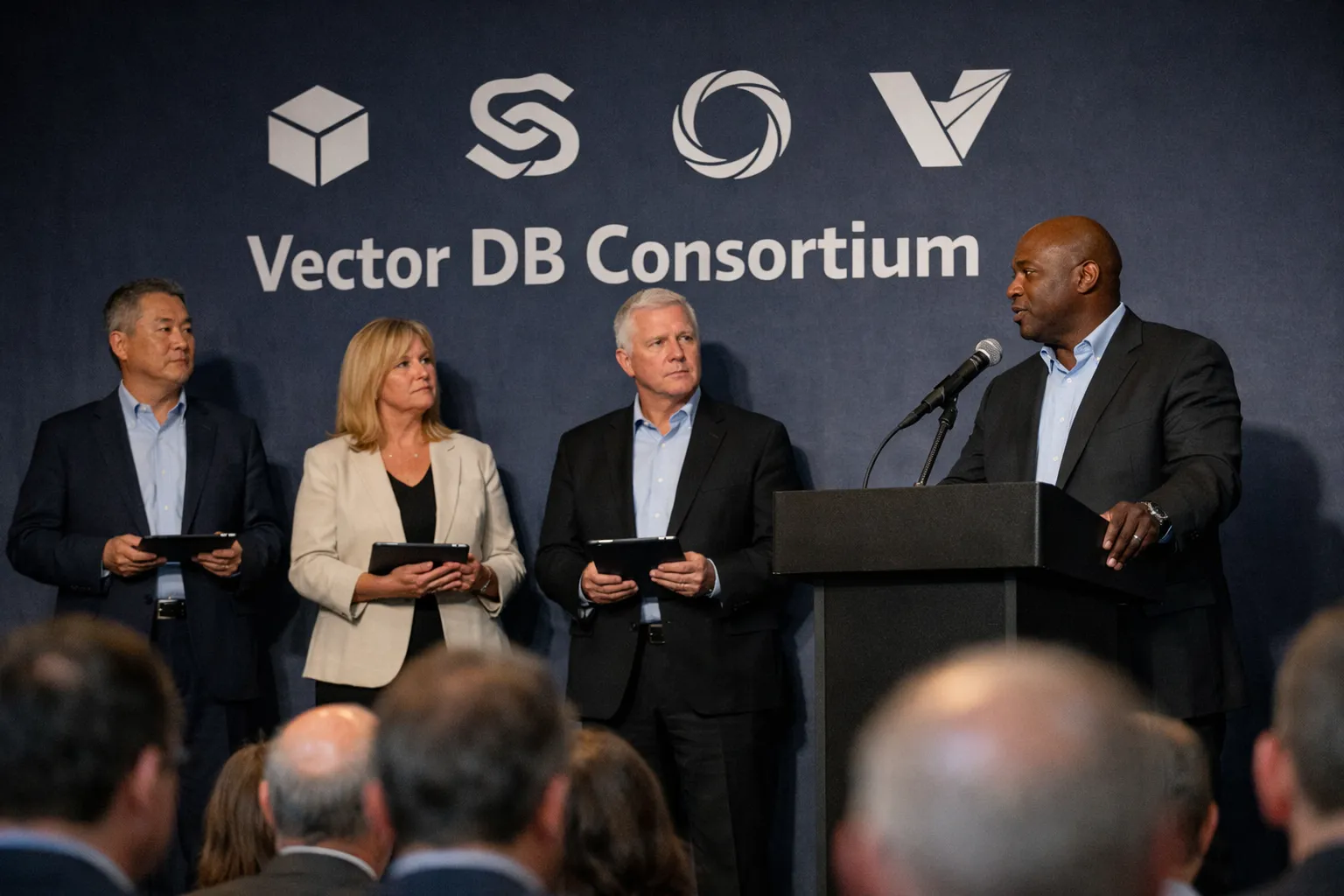
Four major vector-database vendors announced the formation of an industry consortium this week aimed at standardizing embedding APIs, query formats and governance hooks for enterprise AI applications. The coalition—backed by vendors that collectively serve thousands of production deployments—says the work is intended to reduce integration friction, improve portability of models and data, and create clearer operational controls for regulated industries.
Why a standard matters now
Enterprises deploying retrieval-augmented generation (RAG), semantic search and other embedding-driven workflows face a patchwork of proprietary APIs, metadata formats and security models. That fragmentation raises costs: engineering teams must build and maintain adapter layers, MLOps teams struggle to observe and trace vector operations, and legal and compliance teams lack consistent hooks for provenance and access auditing.
“Embedding stores are now a critical part of enterprise AI stacks, and the lack of a de facto standard forces unnecessary custom integration work,” said the consortium’s announcement. Standardization aims to make it easier to swap vector backends, enforce compliance controls centrally and enable richer observability across vendor boundaries.
Core components of the proposed standard
The consortium’s initial draft specification focuses on four practical areas:
- Unified embedding API: A consistent REST/gRPC surface for upsert, similarity search, batch operations and async indexing, designed to reduce adapter code in enterprise middleware.
- Query language and operators: A small, composable set of similarity operators (cosine, dot, Euclidean), weighted hybrid scoring with scalar filters, and pagination semantics for deterministic results.
- Metadata and provenance schema: A vendor-neutral metadata model that includes dataset identifiers, transform lineage, model version tags, and cryptographic provenance placeholders so enterprises can audit vector origins.
- Security and multi-tenancy hooks: Standard headers and token exchange flows to tie vector operations into existing enterprise identity systems, plus role-based access control primitives for index-level isolation.
Expected enterprise benefits
Consortium members argue the specification will bring immediate benefits for large organizations that run heterogeneous AI stacks:
- Interchangeability: Developers will be able to prototype on one vector provider and switch to another in production with fewer code changes.
- Reduced vendor lock-in: A standard API helps procurement teams negotiate service-level expectations and portability clauses that are measurable.
- Faster compliance: A common provenance model makes it easier to demonstrate lineage and data handling to auditors and regulators in finance, healthcare and government.
- Improved observability: Standard telemetry points enable unified dashboards for latency, cost-per-query and drift detection across vector backends.
Industry reaction and caveats
Enterprise architects and MLOps teams greeted the announcement with cautious optimism. Standard APIs could cut months off integration timelines, but they also require buy-in from a wider set of vendors—cloud providers, model-hosting services, and LLM orchestration platforms—that currently expose their own optimizations and value-added features.
Some engineers warned that a lowest-common-denominator standard risks limiting advanced features that differentiate vendors: custom index types, hardware-specific acceleration, hybrid cloud replication and proprietary compression formats. The consortium says the spec is extensible: it defines a stable core with extension points for vendor-specific capabilities.
What this means for procurement and compliance
Procurement teams can leverage the standard to write clearer contract requirements—requesting compliant APIs, provenance fields and SLA test harnesses. Compliance officers benefit from standardized metadata that maps to audit controls and model-risk-management processes, reducing the manual work needed to verify how vectors were generated and used in downstream decisioning systems.
Next steps and roadmap
The consortium plans a staged process: a public draft specification in the coming quarter, followed by reference client libraries in multiple languages and interoperability tests across vendor implementations. The group also said it will publish a “conformance suite” to validate API behavior and metadata fidelity.
Open-source contributors and independent observability vendors are being invited to participate in shaping the spec and contributing connectors and adapters. The consortium emphasized that the goal is not to replace project-level open standards but to offer a practical, enterprise-focused baseline that eases real-world integration.
Why businesses should care today
For AI-for-business teams, the consortium’s work could materially lower the cost of scaling embedding-driven features. Reduced integration time, clearer audit trails and more portable workloads translate to faster time-to-value and lower technical risk—especially for regulated firms that must prove how AI affects customers and decisions.
Adoption will hinge on breadth of vendor support and how well the standard preserves innovation. If the consortium secures participation from cloud hyperscalers, SaaS platforms and key open-source projects, the specification could rapidly become a de facto layer in enterprise AI stacks. If it remains vendor-limited, organizations may continue to rely on bespoke adapters and custom governance layers.
Either way, standardization efforts signal a maturing market: vector stores have moved beyond experimental tooling into core infrastructure, and enterprises now demand predictable, auditable primitives that integrate with procurement, security and compliance frameworks.