Note: IBM announced the watsonx suite in 2023; this review evaluates watsonx.ai as a mature enterprise ModelOps platform in November 2026, focusing on capabilities that matter to AI-for-business teams.
Why this review matters
Enterprise AI buyers in 2026 face more than model accuracy: they need operational model lifecycles, reproducible governance, hybrid deployments for data residency, and vendor fit with existing cloud and on‑prem stacks. IBM’s watsonx.ai is positioned as a ModelOps platform that ties model development, fine‑tuning and governance to hybrid enterprise operations. This review assesses whether it delivers on those promises, and for which enterprise profiles it makes sense.
What is watsonx.ai (quick primer)
Watsonx.ai is IBM’s enterprise ML/LLM offering within the broader watsonx portfolio (announced 2023). It bundles tools for model development, supervised training and fine‑tuning, large model orchestration, and links to watsonx.governance and watsonx.data for policy and data management. The product aims to support open models and commercial models, provide role‑based access, and operate across public cloud and Red Hat/OpenShift-based on‑prem or private cloud environments.
Core components evaluated
- Model development and fine‑tuning workbench
- Model catalog and lifecycle (registry, versioning, lineage)
- Governance integration (policy, auditing, explainability hooks)
- Deployment and inference fabrics (hybrid cloud, private endpoints)
- Integrations (data sources, CI/CD, MLOps tools, OpenShift)
- Support, SLA and enterprise procurement characteristics
Feature-by-feature evaluation
Model development & fine‑tuning
watsonx.ai provides a web-based workbench for experiment tracking, dataset versioning, and model fine‑tuning against customer data. The interface is enterprise-focused, with templates and prebuilt recipes for classification, retrieval‑augmented tasks, and instruction‑tuning workflows. For teams that must adapt open models or licensed commercial models, watsonx.ai supports common fine‑tuning techniques and TPU/GPU-backed training jobs.
Strengths: Integrated dataset management and RBAC controls simplify cross‑team collaboration. Weaknesses: For research‑style experimentation, the environment is less flexible than raw Jupyter + custom infra; heavy customization often requires additional engineering to integrate custom pipelines.
Model registry, lineage & ModelOps
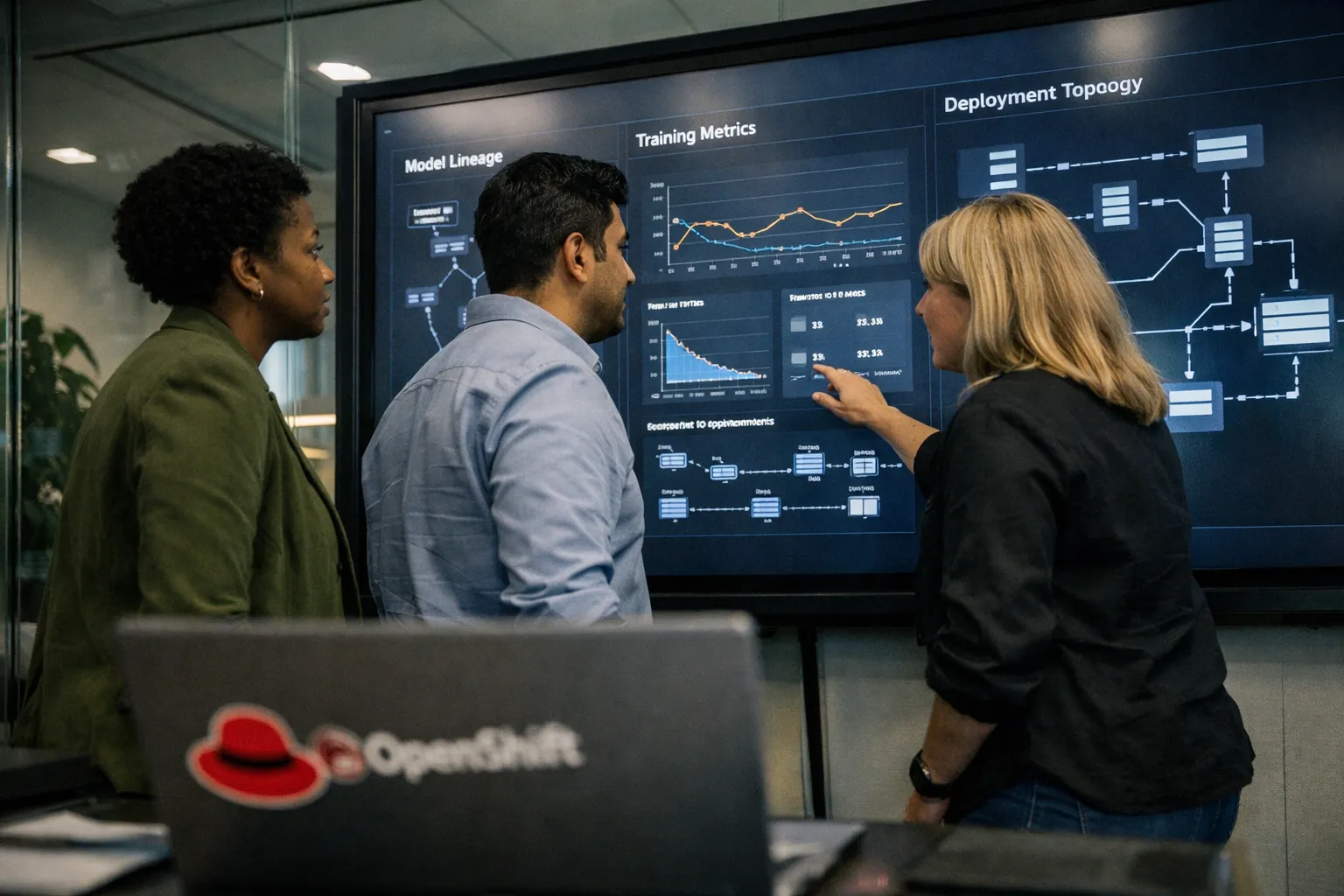
The model registry is central: versioned models with metadata, training artifacts, scorers and evaluation metrics. Lineage captures datasets, code commit IDs and compute configuration, aiding reproducibility and audits. Deployment links from the registry to inference endpoints and CI/CD pipelines reduce operational friction.
Useful detail: enterprise workflows that require traceability from dataset to deployed model are supported natively, but integrating legacy CI/CD systems may require connector work.
Governance, compliance & explainability
Watsonx integrates with watsonx.governance to provide policy enforcement, automated checks, and audit trails. Built‑in tooling surfaces model cards, data provenance and basic explainability outputs (feature importance, attention maps for certain models). These governance hooks are practical for regulated industries that require documentation for AI decisions.
Limitations: Explainability depth varies by model class; for large multimodal models, outputs are often heuristic and need expert review. Regulatory teams should plan for human‑in‑the‑loop review processes despite automated artifacts.
Hybrid deployment & data residency
IBM’s historical strength in hybrid IT shows here: watsonx.ai supports deployments on public cloud and on‑prem via Red Hat OpenShift, enabling private inference and data‑local training. This makes it suitable for organizations with strict data residency or latency requirements.
Operational complexity: Managing a hybrid footprint still demands skilled SRE and platform engineering; watsonx.ai reduces friction but does not eliminate cluster management responsibilities.
Integrations and ecosystem
The platform has connectors for common enterprise data stores, MDM solutions and identity providers (SAML/Single Sign‑On), plus APIs for orchestrating inference at scale. IBM’s enterprise support and systems integrator partnerships can be decisive for large rollouts.
Open model support: watsonx.ai embraces open models and can host tuned versions, which reduces vendor lock‑in risk compared with closed‑model endpoints alone.
Performance, cost and scaling
Performance depends on chosen deployment topology: on‑prem GPU clusters for heavy inference, or cloud instances for bursty workloads. IBM’s commercial pricing typically bundles software licensing, support and optional managed services—so total cost of ownership favors customers already invested in IBM infrastructure or who require enterprise SLAs.
For greenfield teams focused on minimal operational costs and maximal agility, cloud-native alternatives with consumption pricing may present lower short‑term costs.
Pros and cons — at a glance
- Pros: Strong governance artifacts and lineage, hybrid deployment support, enterprise‑grade integration and support, open‑model friendliness.
- Cons: Platform can be heavyweight for small teams, advanced explainability requires additional tooling, hybrid ops demand platform engineering resources, cost can be high for pure cloud-native startups.
Who should consider watsonx.ai?
- Regulated enterprises (finance, healthcare, utilities) that need auditable model lifecycle, data residency and vendor support.
- Large organizations with existing IBM/Red Hat footprints where operational integration reduces rollout friction.
- Teams aiming to maintain control over open models while gaining enterprise governance and lifecycle controls.
Not ideal for: small startups with limited engineering capacity or teams seeking only low-cost, serverless model endpoints without internal governance needs.
Deployment checklist for buyers
- Map governance requirements: required artifacts, retention and human review steps.
- Audit current infra: do you have Red Hat/OpenShift or cloud provider alignment?
- Estimate platform engineering capacity: hybrid ops will require ongoing SRE resources.
- Plan for explainability: identify models that need advanced interpretability tools beyond watsonx.ai defaults.
- Benchmark costs: include licensing, compute, and SI/consulting for initial rollout.
Bottom line
IBM watsonx.ai is a pragmatic enterprise ModelOps platform in 2026: it combines governance, lifecycle management and hybrid deployment options in a package designed for regulated, large‑scale enterprise AI. It is not the cheapest or most lightweight choice, but for organizations that prioritize auditable AI, vendor support and hybrid control, it is a defensible option. Smaller, cloud‑native teams should weigh simpler managed alternatives unless they need watsonx’s specific governance and hybrid strengths.
For AI business leaders, the key decision is whether the cost and operational commitment of watsonx.ai buy significant reduction in compliance, audit time and risk compared with assembling point solutions. If the answer is yes, watsonx.ai is worth pilot investment; if not, evaluate lighter-weight vendors or cloud-native model platforms.