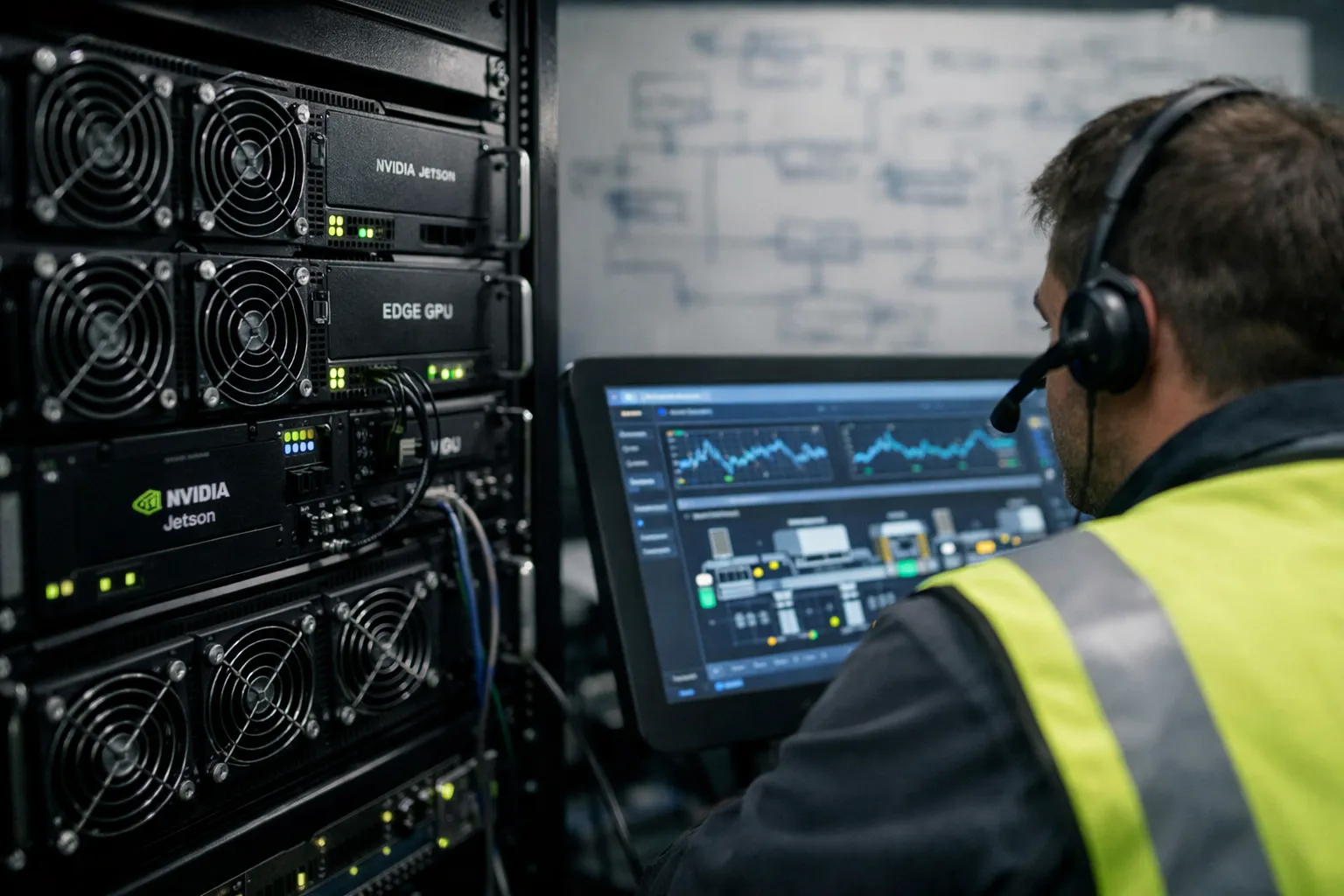
As enterprises push generative AI beyond back‑office automation into operational technology (OT) environments, a new frontier has emerged: running language models and multimodal reasoning at the industrial edge. Between 2024 and 2026, proof‑of‑concepts moved from dashboards and maintenance assistants to closed‑loop advisory systems for assembly lines, energy distribution, and fleet maintenance. That transition raises a specific set of trade‑offs—latency, determinism, safety, lifecycle management and cybersecurity—that deserve focused analysis. This article examines the architectures, performance tradeoffs, governance requirements and vendor choices that enterprises must weigh when integrating real‑time LLM capabilities at the edge.
Why the edge for LLMs now?
Three converging pressures explain the rush to edge LLMs in industrial settings:
- Latency and availability. Control rooms and on‑device assistants require sub‑second reasoning in some scenarios (alerts, operator guidance, control suggestions). On‑cloud round trips introduce variable latency and availability risk.
- Data sensitivity and bandwidth. High‑resolution sensor streams (video, vibration, ultrasonic) are costly to transmit and often cannot leave premises due to IP or regulatory constraints.
- Richer modalities and context. Combining local telemetry, live video, manuals and previous incident logs for immediate troubleshooting benefits from localized retrieval and inference.
Three practical architectures
Enterprises have converged on three pragmatic patterns for edge LLM deployment. Each balances compute cost, latency and operational complexity differently.
1. Tiny local models for deterministic advisories
Architecture: Small transformer models (10M–200M parameters) or distilled LMs run on CPU/low‑power GPU devices colocated with PLCs/edge gateways. Vector indices for local manuals and SOPs are stored on the gateway.
- Latency: millisecond‑level for text reasoning; deterministic behavior if models are constrained.
- Use cases: operator assistance, step‑by‑step troubleshooting, SOP lookup and constrained dialog.
- Pros: low cost, strong privacy, predictable performance.
- Cons: limited world knowledge and generative flexibility; higher engineering effort to craft prompts and robustify outputs.
2. Hybrid edge/cloud orchestration
Architecture: A compact edge model runs first‑pass reasoning and retrieval; complex or high‑confidence tasks escalate to cloud LLMs or a larger on‑prem inference cluster. The edge node performs feature extraction and prioritizes what is sent upstream.
- Latency: local decisions in tens of milliseconds; escalations incur cloud RTT.
- Use cases: anomaly triage, predictive maintenance that requires historical context or heavy compute.
- Pros: balances latency and capability; preserves central observability and governance.
- Cons: requires orchestration logic and robust failure modes for disconnected operation.
3. On‑prem high‑performance inference
Architecture: On‑site GPU clusters (or specialized NPUs) host large models and vector stores inside the plant network, exposing inference via low‑latency APIs to edge controllers.
- Latency: tens of milliseconds to low hundreds, dependent on network topology and batch sizing.
- Use cases: high‑fidelity digital twins, multimodal reasoning combining video and telemetry for automated control loops.
- Pros: full feature parity with cloud models, data residency retained.
- Cons: capital expense, heavyweight ops, and tougher upgrade cycles.
Key technical constraints and metrics
Designing for the industrial edge means engineering to clear, measurable constraints rather than generic "low latency." The most relevant metrics are:
- Control‑loop budget: The maximum allowable latency from sensing to action. Closed‑loop motion control often needs 10 ms; human decision‑support systems can tolerate 100–500 ms.
- Determinism: Variance in response time is as important as median latency. Tail latency must be bounded.
- Throughput: Concurrent inference for many endpoints (e.g., dozens of robots) must be handled predictably.
- Model explainability & reproducibility: Audit trails for model outputs and retrieval provenance are required for safety and regulatory compliance.
- Resource envelope: Power, thermal and compute limitations of edge hardware constrain model size and quantization choices.
Model selection, compression and quantization
For 2026 deployments, enterprises choose between three model classes:
- Specialized small models: Trained on OT corpora and SOPs for deterministic advising. Best for rule‑based tasks.
- Distilled/gated medium models: A compact transformer that handles richer dialog and multimodal tokens but can be constrained with guardrails.
- Large foundational models (on‑prem): Deployed only when the application needs broad reasoning or multi‑step planning and latency can be satisfied by local inference clusters.
Compression techniques—post‑training quantization (8/4/3 bits), structured pruning and LoRA‑style adapters—are standard practice. For safety‑critical advisories, teams must benchmark quantized models on hallucination and calibration metrics specific to the plant data; accuracy regressions from aggressive quantization can be unacceptable in control contexts.
Safety, governance and human‑in‑the‑loop design
Deploying LLMs into environments that affect physical processes requires layered governance:
- Fail‑safe defaults: Edge agents must default to "hold" or human override when model confidence or provenance is insufficient.
- Formal verification of control outputs: For automated actuation, outputs should be translated to deterministic control commands that pass pre‑validated safety checks.
- Provenance and logging: Every inference must log inputs, retrieval keys, model version and confidence scores to an immutable store for post‑incident analysis.
- Periodic retraining and drift detection: Sensor drift or process changes can make on‑device models stale; scheduled evaluation and gated redeployment pipelines are essential.
Operational realities and cost drivers
Key operational tradeoffs drive total cost of ownership:
- Hardware amortization: GPUs and NPUs deployed for LLMs often sit idle outside peak times—careful capacity planning and multi‑tenanting with analytics workloads improves utilization.
- Connectivity assumptions: Hybrid designs reduce cloud spending but increase development complexity and require resilient software for disconnects.
- Maintenance: On‑prem models need patch cycles, security updates and specially trained staff—skills that OT organizations may lack. Managed on‑prem offerings from hyperscalers can reduce burden but cost more.
Vendor and ecosystem landscape
By 2026, the ecosystem is fragmented into three camps:
- Cloud vendors with edge toolkits (AWS IoT Greengrass, Azure IoT Edge): Simplify orchestration and security, and offer managed on‑prem inference appliances.
- Specialized edge inference firms providing quantized runtimes and real‑time schedulers optimized for OT environments.
- OT incumbents and system integrators offering verticalized bundles—digital twins, OPC UA integration and hardened runtimes tailored to manufacturing and energy use cases.
Enterprises often combine players across these camps: a cloud provider for centralized model training, a specialized runtime for quantized inference, and an OT integrator for plant deployment and safety certification.
Case snapshots (anonymized)
- Automotive plant (hybrid pattern): A manufacturer deployed a small local LLM on edge gateways to triage line stoppages; escalations with telemetry and video thumbnails flow to an on‑prem inference rack for deeper analysis. Result: 35% faster mean time to repair, with human‑in‑loop signoff for any suggested actuator changes.
- Energy distribution operator (on‑prem pattern): A regional grid operator runs multimodal reasoning on a private datacenter inside the control center to generate operator advisories for outage response; strict audit logging and deterministic throttling govern automated recommendations.
Checklist for decision‑makers
- Define latency and determinism requirements per control loop; measure them end‑to‑end.
- Map data residency and bandwidth constraints to an architecture (local, hybrid, on‑prem).
- Prototype with a small specialized model on representative hardware; benchmark hallucination, tail latency and power use.
- Design mandatory fail‑safe behaviors and audit logging before any actuation integration.
- Plan for model lifecycle: drift detection, retraining cadence and secured model artifact storage.
- Engage OT compliance and safety teams early; factor certification timelines into rollout plans.
Conclusion
Real‑time LLMs at the edge can materially improve operational responsiveness and situational awareness in industrial environments, but they are not a drop‑in replacement for deterministic control logic. The right approach is pragmatic: move high‑risk closed‑loop decisions behind formal safety checks, use compact localized models where possible, and reserve large models for on‑prem inference clusters or cloud escalation. For 2026 adopters, success will hinge less on chasing the largest model and more on engineering for latency, auditability and predictable behavior inside the constraints of OT environments.