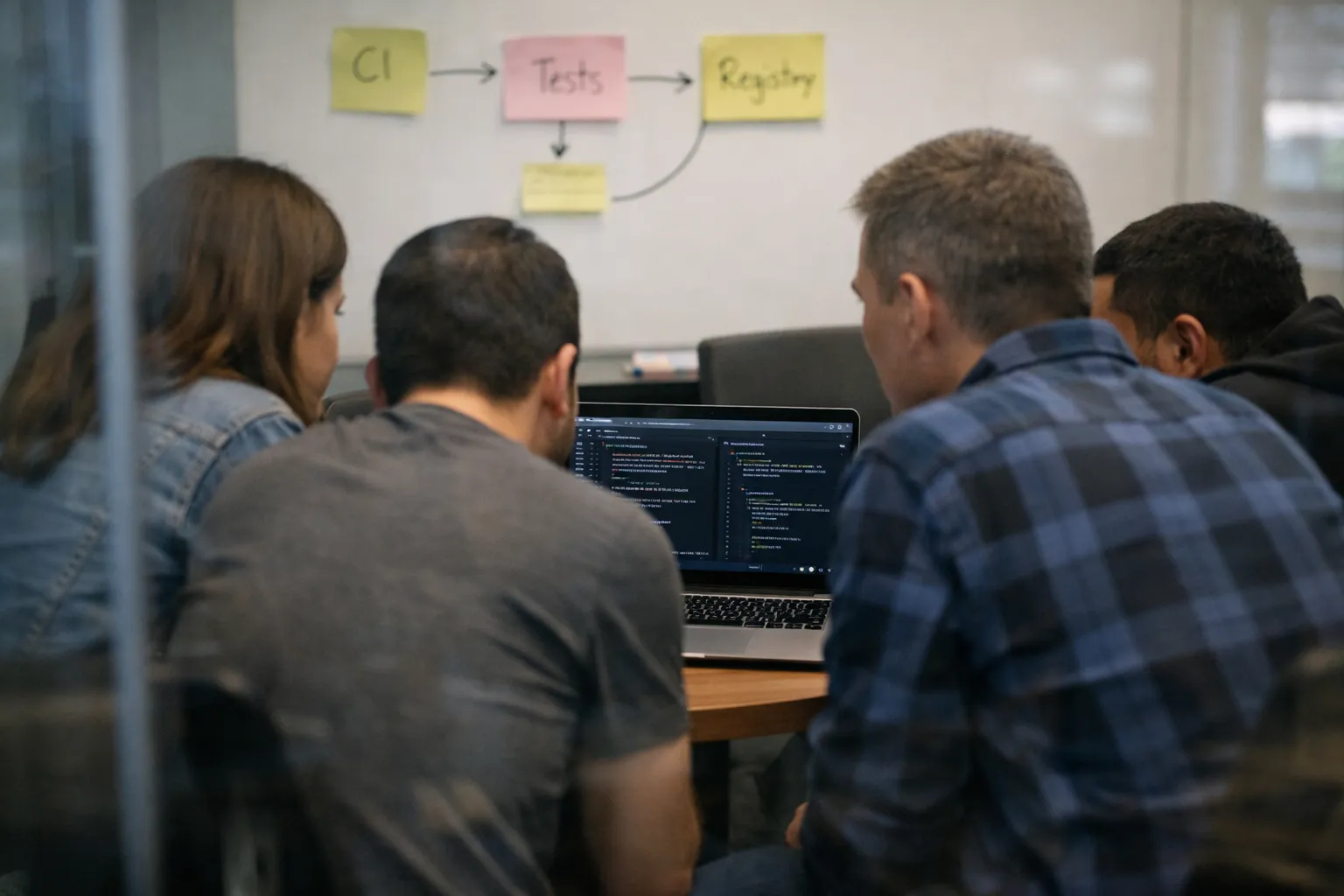
What you will learn: This update brings the June 2026 prompt-governance framework current for November 2026. It explains what changed in the last five months, which metadata and runtime controls now matter, and how to operationalize governance across CI/CD, telemetry and audit workflows. Target audience: AI product owners, MLOps engineers, compliance leads and prompt engineers building production LLM features.
Prerequisites & context: what to know before you start
- Prompts are production artifacts: treat templates, examples and metadata like code, test data and deploy manifests.
- Hybrid model stacks are pervasive: hosted APIs, private fine-tuned models, retrieval-augmented systems and on-prem micro-models coexist and change independently.
- Regulatory and procurement scrutiny increased in 2026: auditability, provenance and demonstrable controls are baseline expectations for regulated domains.
- Operational economics matter: token cost, compute receipts and SLOs are routinely reconciled with finance and product KPIs.
What changed since mid‑2026 (high‑level trends)
Between June and November 2026 three practical shifts accelerated governance needs:
- Stronger provenance tooling: Prompt registries and model providers added cryptographic signatures, exportable manifests and “compute receipts” that record which model, infra and geographically limited compute ran each inference.
- Regulatory readiness and audits: Auditors now expect exportable artifacts that link prompts to model manifests, retrieval snapshot IDs and reviewer signoffs. Many teams now produce packaged “deployment bundles” for audits.
- Operationalized adversarial testing: Teams moved from static red-team lists to automated LLM-based adversarial generators and scheduled retraining of test corpora (weekly or biweekly) to keep pace with emergent attack vectors.
High-level governance workflow (updated for Nov 2026)
- Define an expanded prompt artifact schema including cryptographic provenance and certified compute receipts.
- Version prompts with intent-aware semantic tags and release channels; attach risk and SLO metadata.
- Build and continuously evolve a test corpus: unit, integration, adversarial and cross-model compatibility suites.
- Automate tests in CI/CD; gate merges with cost and safety thresholds and orchestrate staged rollouts (shadowing + canaries).
- Deploy with enriched telemetry: per-call provenance, watermark flags, and drift detectors that map to business metrics.
- Enforce RBAC, multi-party approvals and immutable audit bundles in a prompt registry that can export neutral manifests for auditors.
1. Standardize prompt artifacts and metadata (Nov 2026 additions)
Treat the prompt file, examples and metadata as a single deployable artifact. In addition to earlier fields, add the following to your standard schema:
- provenance_signature — cryptographic signature tying the prompt, metadata and approved policy_document_hash to the registry entry.
- certified_compute_receipt — reference or hash to the compute receipt that records the model instance, hardware class (e.g., CPU/GPU/TPU), and regional execution location for approved production runs.
- watermark_enabled — boolean plus watermark scheme identifier when vendor or in‑house watermarking is used for provenance of outputs.
- data_access_policy_id — pointer to the access-control policy for any retrieval sources used by this prompt (required for regulated data).
- experiment_id — links to A/B experiments, rollout cohorts and metric baselines used to validate the change.
- drift_baseline_hash — snapshot id or embedding centroid hash for the input distribution baseline used in drift detection.
Store metadata as YAML/JSON in Git alongside the template and push an immutable manifest to your central registry. Ensure your registry can export a neutral, human- and machine-readable bundle for audits.
Example metadata (JSON, Nov 2026)
{
  "prompt_id": "legal/contract_summary",
  "version": "1.4.2",
  "template": "Summarize the following clause for a business user: {{clause_text}}",
  "examples": {"positive": [{"clause_text": "...", "summary": "..."}]},
  "model_constraints": {"temperature": 0, "max_tokens": 300},
  "model_manifest_id": "vendorX/gptx-2026-finetune:v2",
  "provenance_signature": "sig:ed25519:Z3Vlc3Q...",
  "certified_compute_receipt": "receipt:cb7f... (hash, timestamp, region)",
  "watermark_enabled": true,
  "privacy_budget": null,
  "retrieval_config": {"enabled": true, "index_id": "legal-index-v7"},
  "deployment_constraints": {"canary_percent": 2, "max_qps": 50, "regions": ["us-west-2"]},
  "security_tags": ["legal","confidential"],
  "owners": ["legal-ai@company.com"],
  "approvers": ["director-legal-ai","compliance-lead"],
  "test_suite_ref": "tests/legal_contract_summary_tests",
  "policy_signoff_hash": "sha256:abc123",
  "data_access_policy_id": "dap:legal-restricted-v3",
  "experiment_id": "exp/contract_summary/2026-11-A",
  "cost_estimate": {"tokens_in": 150, "tokens_out": 220, "monthly_estimate_usd": 420}
}
2. Version prompts with intent‑aware semantics (refinements)
Continue to use semantic versioning but make intent explicit and machine-readable:
- Use MAJOR.MINOR.PATCH and append a single or multi-label intent array: e.g., {"intent":["safety-tweak","cost-optimization"]}.
- Tag release channels—dev, staging, canary, stable—and record the channel in the registry manifest.
- Include a compact risk assessment in the changelog: expected metric deltas (cost, latency, hallucination), tests added, rollout strategy and required approver roles.
3. Build an evolving test corpus: unit, integration, adversarial and compatibility suites
Testing is continuous. Update your practices to November 2026 expectations:
- Unit tests: structural checks (JSON schema), banned-token filters, cost regression checks. Use deterministic model seeds or local lightweight models for quick feedback.
- Integration tests: staging runs against sanitized retrieval snapshots and a “near-production” model manifest. Persist raw outputs and checkpoints for auditability.
- Adversarial tests: automated LLM-based red teams generate edge cases; schedule weekly regeneration of adversarial corpora to detect new prompt-injection patterns.
- Cross-model compatibility: run prompts against candidate vendor and in-house models; include acceptance ranges rather than exact matches to reduce false failures.
Recommended pass/fail thresholds (guidance, adjust for business needs): extraction F1 ≥ 0.92 for critical flows, hallucination ≤ 1.0% for regulated outputs, latency P95 ≤ 600ms for interactive experiences, and cost delta ≤ +5% vs baseline. Persist all artifacts for audits.
4. Integrate prompts into CI/CD (practical steps)
- Open a feature branch and update the prompt template, metadata, intent tags and changelog with explicit risk notes.
- Run CI unit tests with deterministic mocks; publish results and artifact hashes to the registry.
- If units pass, run integration tests in a disposable staging environment using a retrieval snapshot and candidate model manifests; store certified_compute_receipt for the run.
- Gate merges: require automated test pass, cost delta within threshold, and signoffs for sensitive security tags. Automate approvals where possible but require human signoff for regulated tags.
- On merge, orchestrate staged rollout (shadow -> canary -> ramp) tied to experiment_id and rollback criteria. Use dual-execution or shadowing to compare outputs without user impact.
Include cost estimation, compute receipt generation and policy checks in your pipeline (e.g., GitHub Actions, GitLab CI, Jenkins, or cloud-native pipelines). Store immutable release artifacts and export a deployment bundle for auditors.
5. Runtime telemetry, watermarking and drift detection
Per-call telemetry should be richer in late‑2026:
- Per-call headers: prompt_id, prompt_version, model_manifest_id, retrieval_index_version, tokens_in/out, latency, region, certified_compute_receipt.
- Output signals: schema validation pass/fail, hallucination heuristics score, watermark flag (if enabled), and downstream conversion or compliance markers.
- User signals: thumbs, escalate-to-human, and post-handoff correction labels.
Stream logs and metrics to a centralized observability stack and run automated drift detection: distribution drift (KL divergence) on token/embedding spaces, retrieval-quality drift (recall/precision), and business-metric drift (conversion, escalations). Map drift alerts to specific remediation playbooks (retest, rollback, reindex retrieval sources).
6. Access control, approvals and audit bundles
Enterprises now produce audit bundles for regulated prompts. Implement:
- RBAC on registries and repositories; enforce multi-party approvals for regulatory or high-risk tags.
- Immutable audit records that include prompt diffs, test results, approver IDs, certified compute receipts and provenance signatures.
- Exportable audit bundles: a single archive that contains the prompt template, metadata, changelog, signed approvals, test artifacts and a sample of runtime logs.
7. Managing model changes and cross-model compatibility
Treat model updates with the same discipline as prompt edits:
- Run compatibility suites against candidate model manifests before any model upgrade in production.
- Define metric gates (business-metric deltas) and automatic rollback criteria. Record model_manifest_id in all runtime logs for traceability.
- For critical tasks, maintain a “warm” fallback model and an automated switchable path that preserves SLOs during rollback.
8. Human‑in‑the‑loop and escalation patterns
Refine human workflows:
- Use structured handoff signals (confidence bands, schema flags) for automated routing to reviewers.
- Use progressive automation: higher review rates during early rollouts and targeted review for flagged outputs thereafter.
- Persist reviewer corrections as training examples or test cases; version them alongside prompts.
9. Example November 2026 update: contract-summary prompt
- Metadata now includes provenance_signature, certified_compute_receipt and data_access_policy_id. Watermarking is enabled for external-facing summaries.
- Test corpus expanded to 1,200 anonymized clauses; adversarial suite regenerated weekly by an LLM red team. Cross-model tests include two vendor APIs and an on-prem model.
- CI runs deterministic unit tests, integration runs generate certified_compute_receipts, and release is gated by legal + compliance signoff.
- Change labeled ["safety-tweak","watermark-enable"]. Canary rollout: 1% → 5% → 20% with shadow validation. Rollback if hallucination increases >0.5pp or conversions drop by >3%.
- Telemetry captures watermark flags, hallucination scores and certified_compute_receipt logs for all canary calls; an automated audit bundle is prepared at release time.
10. Practical tools and vendor-choice guidance (Nov 2026)
- Pick a prompt registry that supports cryptographic provenance, certified compute receipts and exportable audit bundles if you operate in regulated domains.
- Integrate registry and Git as the canonical source-of-truth; ensure CI produces immutable artifacts that can be rehydrated for audits.
- Prefer staged rollouts with shadowing over blind switches for high-impact prompts.
- Automate adversarial case generation and schedule periodic regeneration (weekly or biweekly) to stay ahead of prompt-injection patterns.
- Record model_manifest_id, retrieval index versions and compute receipts on every production call for full traceability.
Common mistakes to avoid
- Keeping prompts in unversioned documents or spreadsheets — destroys reproducibility and auditability.
- Using exact-string matching for outputs instead of structural checks and tolerance windows.
- Assuming model swaps are risk-free — cross-model tests are required for safe rollouts.
- Omitting cost and compute receipts — token/compute spend surprises are common when prompts drift.
- Neglecting to refresh adversarial corpora — attack patterns evolve rapidly and need scheduled regeneration.
Pro tips
- Store a small set of canonical golden inputs and run them in nightly regression suites; persist model outputs and compute receipts for reproducibility.
- Automate adversarial-case generation by seeding an LLM red team with known failure modes and rotation prompts; integrate this into CI as a nightly job.
- Expose clear cost impact in PRs: estimated monthly delta, per-call token change and sensitivity to QPS—automate rejection when thresholds are exceeded.
- Where output provenance matters externally, enable watermarking and include watermark verification logic in downstream validators.
- Separate immutable system instructions from changeable templates; reference the system instruction version in the prompt metadata to avoid hidden behavior shifts.
FAQ
How granular should prompt versioning be?
Version by semantic intent. MAJOR for breaking schema or output-format changes; MINOR for behavior, safety, or performance improvements; PATCH for metadata, tests, or typo fixes. Add explicit intent tags (e.g., "safety-tweak","cost-optimization") and attach release-channel metadata so reviewers know which tests matter.
Can we test without calling costly hosted models?
Yes. Use deterministic local mocks or distilled models for fast unit feedback. Reserve integration and cross-model compatibility tests for staging where you run candidate models and retrieval snapshots. Persist real integration outputs and certified compute receipts for auditability.
What minimum telemetry should we capture per call?
At minimum capture: prompt_id, prompt_version, model_manifest_id, tokens_in, tokens_out, latency, retrieval_index_version, region and a schema pass/fail. Add certified_compute_receipt and watermark flags when provenance is required. Also capture user feedback and escalation events.
How do we prepare an audit bundle?
Produce a single exportable archive containing: the prompt template and metadata, version and changelog, cryptographic provenance and policy signoff hashes, full test-suite results with timestamps, approver identities, model manifests, retrieval snapshot IDs and a sample of runtime logs with certified compute receipts. Keep immutable copies in your registry and a secure archival store.
When should human review be required?
Require human review for high-risk domains (legal, finance, safety) on low-confidence outputs and during early rollouts. Use progressive automation: higher review rates early, then reduce reviews as telemetry stabilizes and key metrics meet thresholds. Log reviewer corrections and add them to your test suites.
Conclusion
Prompt governance is now mature enough that operational controls—provenance signatures, certified compute receipts, watermarking and automated adversarial regeneration—are practical to implement. Start small: pick one high-impact prompt, add extended metadata, build a 50–200 example test suite, integrate it into CI/CD and enable per-call telemetry with a compute receipt. Iterate from there: those steps materially reduce surprise, control cost and create the traceability compliance teams expect in late 2026.