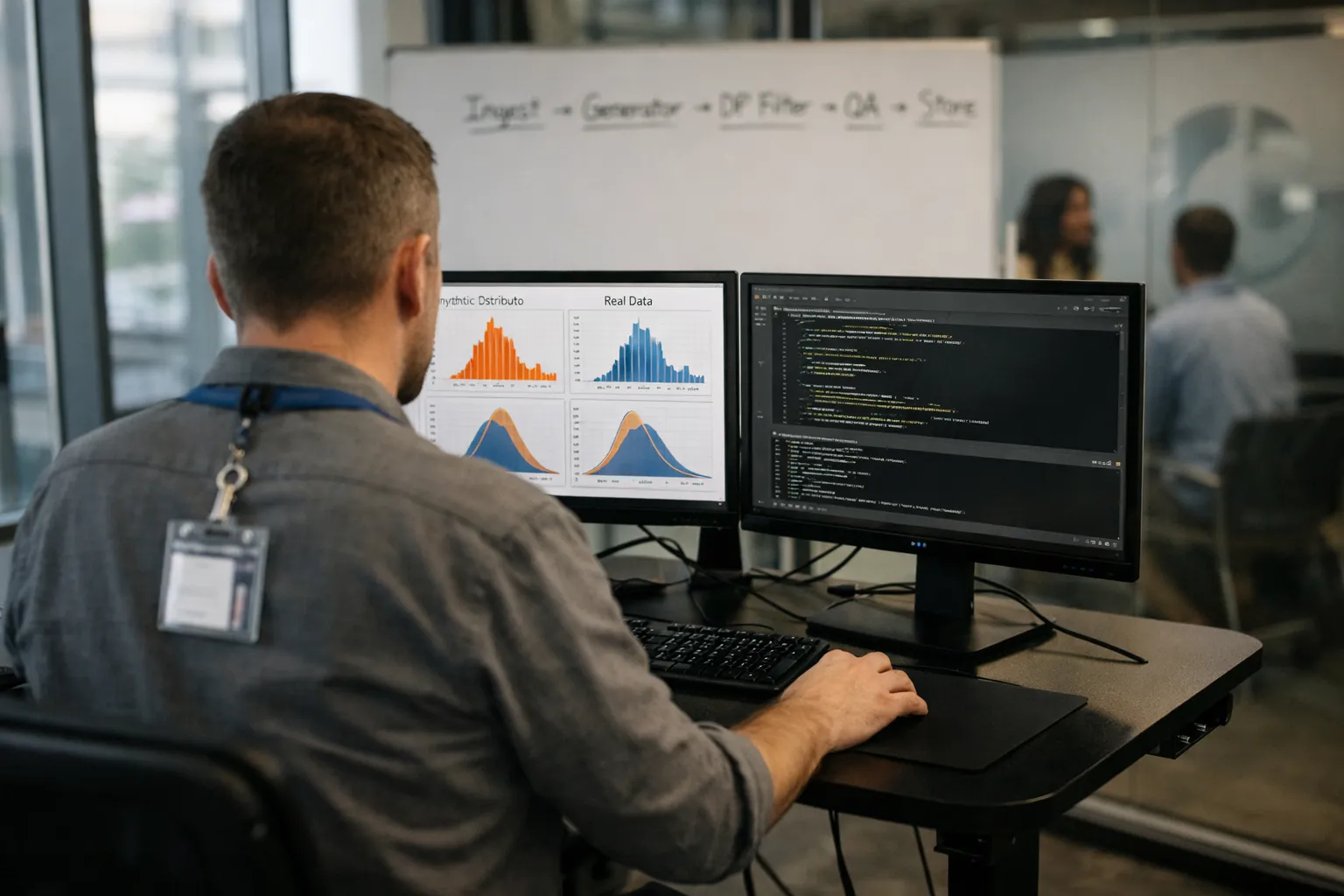
Enterprises continue to adopt synthetic data as a core enabler for faster model development, safer data sharing, and scalable test environments. This October 2026 update tightens the operational playbook with lessons from early adopters this year: more mature generator architectures for tabular/time-series, better privacy controls for LLM-based text synthesis, and stronger governance patterns for auditable synthetic datasets. This guide is for AI-for-business practitioners—data engineers, ML engineers, product managers and compliance leads—who need a concrete, production-ready playbook to design, build and govern synthetic data pipelines today.
Prerequisites and context
Before you begin, make sure your organization has:
- A documented data classification policy that marks PII/PHI and quasi-identifiers.
- Legal and privacy contacts who can approve DPIAs and dataset use policies.
- An MLOps baseline: model and dataset registries (e.g., MLflow or in-house), CI/CD for data and models, and audit logging.
- A secured compute enclave or sandbox for generator training and sensitive-data profiling (no public internet egress for raw-data work).
Why this matters: synthetic data is not a silver bullet. It reduces exposure to raw records but introduces new operational risks—uncontrolled memorization, distribution mismatch, and policy gaps—that must be managed through engineering and governance.
Step 1 — Scope and objectives (updated practices)
- Define measurable goals:
- Primary objective (e.g., reduce analyst access to PII by 80% for exploratory work; augment minority classes by 3x while maintaining model recall within 2 percentage points).
- Acceptance criteria: concrete thresholds for ML utility (delta AUC, calibration shift), privacy (max uniqueness, allowed DP epsilon), and operational SLAs (generation latency, cost per row).
- Map stakeholders and downstream uses:
- Classify downstream systems by risk (internal analytics, external partner sharing, model training for regulated products) and assign approval gates accordingly.
Step 2 — Inventory, profiling, and lineage
- Catalog sources and tag sensitivity:
- Use a data catalog to tag columns as direct identifiers, quasi-identifiers, sensitive attributes, and business keys.
- Record retention policies and regulatory constraints (GDPR, HIPAA, PCI-DSS where applicable) at the dataset field level.
- Profile with production-grade metrics:
- Collect distributions, cardinalities, missingness patterns, and key correlations. Capture temporal behavior for time-series and event logs.
- Store profiling artifacts in the registry so generator training is reproducible and auditable.
Step 3 — Risk assessment and governance policy (what’s new in 2026)
- Perform a DPIA tailored to synthetic use:
- Include attacker models specific to your context (insider threat, external partner with auxiliary data, or adversarial LLM probing).
- Define allowed uses and a certification workflow for dataset promotion. Many teams now require a "synthetic attestation" document that summarizes privacy controls and utility metrics.
- Operationalize privacy thresholds:
- Translate privacy goals into engineering parameters (target DP epsilon, maximum record uniqueness, permitted percentage of quasi-identifier overlap with real data).
- For high-risk applications (regulated credit decisions, healthcare), require formal DP mechanisms and lower epsilon targets; for low-risk internal analytics, require empirical attack tests and documented limits.
Step 4 — Choose generation methods (2026 capabilities and trade-offs)
Match generator families to modality and risk profile. New in 2026: diffusion and score-based methods for tabular/time-series have become common alternatives to GANs, offering improved mode coverage; foundation models for structured data and LLM-based pipelines have clearer operational patterns but need stronger memorization controls.
- Modality mapping:
- Tabular: conditional diffusion/tabular flow models or CTGAN-style methods with explicit privacy layers. Use conditional generators to preserve label balance and rare class support.
- Time-series / event logs: temporal diffusion, transformer-based sequence generators, or simulator-driven approaches for rare tail events.
- Text / dialogs: LLM-conditioned generation with RAG for factual grounding; always include memorization and membership testing when fine-tuning or prompting on sensitive corpora.
- Images / video: synthetic rendering for labeled supervisory signals or diffusion models with synthetic annotation pipelines.
- Hybrid patterns:
- Use deterministic scrubbing (tokenization, date bucketing) and rule-based PII removal before generation. Apply generative models only to the sanitized dataset to reduce leakage risk.
- For rare-event fidelity, combine scenario-based simulation with learned generators rather than relying on pure statistical mimicry.
Step 5 — Build the pipeline (detailed and actionable)
Design components as composable, versioned services. Numbered architecture checklist:
- Ingestion & profiling
- Sandboxed extractor that records lineage and stores provenance metadata (table/column versions, snapshot timestamp).
- Profile artifacts saved with dataset version for reproducibility.
- Preprocessing and scrubbing
- Apply deterministic transformations: tokenization, hashing with salt for pseudonyms, date bucketing, and noise injection where required by policy.
- Record transformation scripts and container images in the registry.
- Generator layer
- Containerized generator jobs with GPU acceleration where needed. Parameterize seeds and hyperparameters; store them as metadata.
- For LLM pipelines, separate model hosting from prompt templates and grounding sources; log prompts, context, and model IDs for audit.
- Privacy enforcement
- Implement DP mechanisms where required. Use DP-SGD for generator training or DP post-processing for outputs; record epsilon budgets against dataset versions.
- For non-DP approaches, enforce k-anonymization thresholds, output filtering and differential testing against holdouts.
- Quality checks and gating
- Automated test suites for statistical fidelity (KS, chi-square, MMD), ML utility (train-on-synthetic, test-on-real), and disclosure risk (nearest-neighbor, membership inference simulations).
- Fail gates must prevent promotion to shared stores until both utility and privacy thresholds are met.
- Storage, access and audit
- Store synthetic datasets in separate, access-controlled buckets. Attach machine-readable metadata: generator ID, privacy parameters, test results, approver signatures, and retention rules.
- Maintain immutable audit logs for who generated what and when; integrate with SIEM or governance tooling for long-term retention.
Step 6 — Validate utility and disclosure risk (practical tests)
Validation is both statistical and adversarial. Define a validation suite that runs automatically and records results in the registry.
- Utility tests
- ML efficacy: train the production model architecture on synthetic training sets and evaluate on a small, tightly controlled real-data holdout. Track delta AUC, precision/recall shifts, calibration curves and subgroup fairness metrics. A common enterprise threshold remains =2–3% delta in primary metric unless use case demands tighter parity.
- Statistical fidelity: run marginal and joint distribution tests, pairwise correlation residuals, and coverage metrics (support overlap, synthetic sample reach for rare cells).
- Privacy tests
- Re-identification simulations: nearest-neighbor matching, record uniqueness checks, and simulated linkage attacks using realistic auxiliary data when available.
- Membership inference and memorization: run membership inference attacks, prompt-based memorization probes for LLM outputs, and sample-based reconstruction tests.
- Formal DP accounting: compute or bound epsilon for generators using DP mechanisms; record privacy budget consumption and amortize across dataset promotions.
- Gate criteria: promote datasets only when both privacy and utility thresholds set in Step 1 are satisfied and an approver has signed the synthetic attestation.
Step 7 — Deploy, monitor and audit (operational realities)
- Dataset versioning and metadata
- Publish synthetic datasets as data products with version, generator model ID, privacy guarantees, evaluation artifacts, and usage restrictions.
- Continuous monitoring
- Monitor distribution drift between synthetic and incoming real data (feature-level drift, correlation change) and retrain generators or refresh datasets when drift exceeds thresholds.
- Track downstream model performance drift for models trained with synthetic data—set alerts when production metrics deviate beyond agreed tolerances.
- Audits and retention
- Keep auditable artifacts: raw profiling logs, generator configs, DPIAs, and test results. Archive these in line with compliance windows.
Concrete architecture example — HR churn (revised for Oct 2026)
Objective: enable HR analysts to run experiments without access to employee PII while keeping a secure small holdout of real data for validation.
- Data sources: HRIS (PII), engagement surveys (free text), access logs (event sequences), and payroll aggregates.
- Pipeline sketch:
- Profile raw data inside an air-gapped sandbox and produce a provenance manifest.
- Pseudonymize direct identifiers with one-way salted hashing; tag quasi-identifiers and limit quasi-identifier cardinality with bucketing rules.
- Train a conditional tabular diffusion model for demographics and tenure; a transformer-based sequence generator for access logs; and an LLM text synthesizer for de-identified survey responses using RAG to preserve topic structure without reproducing verbatim text.
- Apply DP at either the generator training stage (DP-SGD) or via calibrated output-noise, targeting epsilon consistent with your DPIA—common enterprise target: epsilon ≤1 for high-risk use, epsilon 1–4 for lower-risk internal analytics depending on controls.
- Validate by training the churn model on synthetic augmented data and measuring AUC on the secure real holdout (require ≤2% AUC drop). Run re-identification testing with nearest-neighbor and membership-inference simulations; require uniqueness 0.1% and membership inference below acceptable threshold.
- Publish dataset with metadata, usage policy and a synthetic attestation; enable analyst access in a controlled notebook environment with no external egress and logging of all queries.
Tooling and libraries (pragmatic 2026 checklist)
Tool selection depends on modality and enterprise constraints. When evaluating tools, prioritize: reproducible model versioning, integrated privacy libraries, and audit-friendly metadata export.
- Generator frameworks: evaluate diffusion/tabular-flow implementations, CTGAN-family tools, and transformer/sequence generators suitable for event logs.
- LLM pipelines: use retrieval-augmented generation (RAG) with grounded knowledge sources and memorization tests; separate prompt templates from model weights for auditability.
- Privacy libraries: use established DP toolkits for model training or post-processing; use k-anonymity and output-filtering libraries where DP is infeasible.
- Orchestration & governance: integrate with workflow orchestrators (Airflow, Prefect), model and dataset registries (MLflow or equivalents), and data catalogs for lineage and approvals.
KPI and acceptance metric examples
- Model utility: delta AUC/F1 ≤2–3% (case by case), calibration shift ≤0.05 Brier change, subgroup parity within defined bounds.
- Statistical fidelity: marginal distribution KS p-value above threshold, MMD below target, coverage of rare cells ≥ required support.
- Privacy: uniqueness fraction ≤0.1% for de-identified public sharing; membership inference success rate below tolerated level; DP epsilon logged and auditable.
- Operational: generation latency (minutes for small datasets, hours for large batch runs), cost per synthetic row, reproducibility score (all artifacts versioned), and time-to-share SLA (target 1–5 days for certified dataset delivery depending on size and review level).
Common mistakes and how to avoid them
- Overfitting generators and memorization — mitigated by holdout regularization, early stopping, differential privacy when required, and explicit memorization tests for LLM outputs.
- Replacing real validation — always retain a small, secured real-data holdout for final validation and drift checks.
- Skipping governance — synthetic datasets still need DPIAs, approval gates and documented allowable uses; enforce attestation and versioned metadata.
- Assuming synthetic reproduces tail events — for rare or adversarial events, prefer scenario-based simulation or targeted synthetic pipelines rather than general-purpose generators.
Pro tips (operational best practices)
- Automate the synthetic attestation: generate a summary PDF/JSON that includes generator model ID, privacy parameters, evaluation results and approver signatures stored with the dataset version.
- Use model-in-the-loop generation for downstream tasks: iterate generator training using feedback from downstream model performance to improve utility where permitted by policy.
- Schedule periodic re-certification: re-run privacy and utility tests on a cadence tied to data volatility (monthly for fast-moving domains, quarterly otherwise).
- Keep prompt and grounding templates for LLM-based generators under version control and treat them as first-class artifacts in reviews.
FAQ
When should we prefer differential privacy over empirical attack testing?
Prefer DP when your use case is high risk (regulated decisions, public releases, or broad external sharing) and you can tolerate some utility loss and the engineering cost of DP training. Empirical attack testing and filtering are acceptable for lower-risk internal analytics if paired with strong governance and controlled access, but they do not provide the mathematical guarantees DP provides.
How large should the real holdout be for validation?
There’s no one-size-fits-all number. Practical guidance: keep a holdout large enough to estimate your primary metric with acceptable confidence—commonly 5–10% of the original labeled dataset or enough examples to have at least several hundred positive-class instances for rare-event models. Adjust based on class prevalence and risk tolerance.
Can we use synthetic data to certify compliance under GDPR or similar laws?
Synthetic data can reduce compliance burden but does not automatically remove obligations. GDPR still requires that controllers document processing activities and assess risks. Use synthetic data to minimize PII exposure, but complete a DPIA and consult legal counsel before using synthetic data as a compliance substitute for regulated processing.
How often should we retrain the generator?
Retrain when synthetic vs. real drift exceeds thresholds or when downstream model performance degrades. For dynamic domains, schedule automated retrain triggers (weekly or monthly) based on drift signals; in stable domains, quarterly retraining may suffice. Tie retrain frequency to business needs and monitoring alerts.
What’s a reasonable privacy budget (epsilon) to target?
Privacy budgets depend on risk posture. Many enterprises target epsilon ≤1 for high-risk external sharing; epsilon 1–4 is common for controlled internal analytics with strong governance. If DP is infeasible, use empirical risk targets (uniqueness, membership-inference rates) and compensating controls (restricted access, attestation).
Final recommendations
In October 2026 the synthetic data ecosystem provides mature building blocks—but the differentiator is disciplined operationalization. Treat synthetic datasets as products: define measurable goals, bake privacy-by-design into pipelines, automate attestations and audits, and insist on a secure real-data holdout for final validation. Start with a focused pilot and scale only after demonstrating reproducible utility and documented privacy controls.