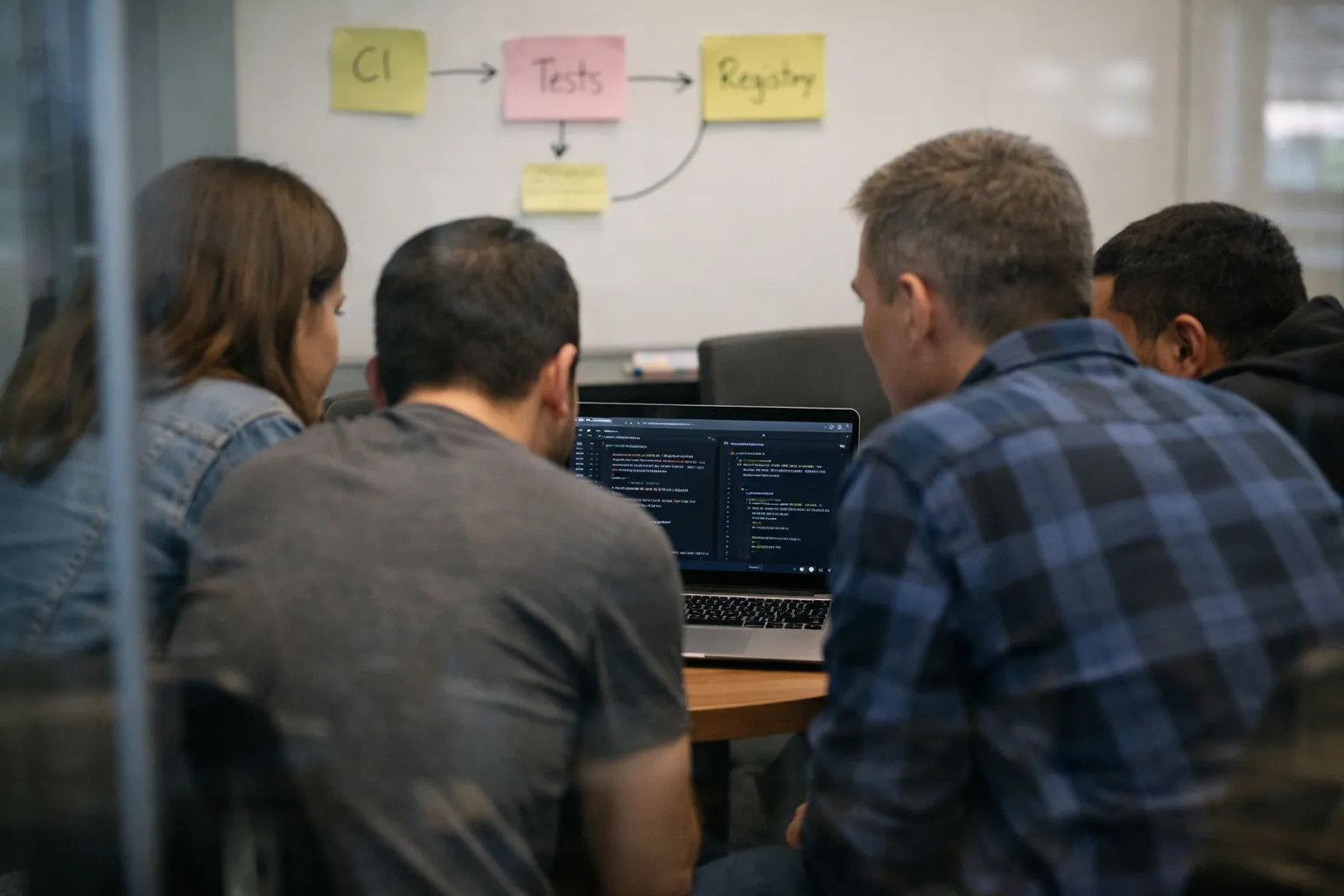
Enterprises building production LLM capabilities continue to encode business logic, safety controls and UX into prompt templates and examples. Between March and June 2026 the operational footprint of prompts has only grown: prompts now appear in transaction flows, regulatory workflows and automated decisioning, and organizations are adopting more formal governance to manage cost, safety and compliance.
This guide updates a practical, repeatable approach to prompt governance. It covers current best practices for standardizing prompt artifacts, intent-aware versioning, automated tests, CI/CD integration, runtime telemetry, drift detection, approval workflows and audit trails. Target audience: AI product owners, MLOps engineers, compliance leads and prompt engineers responsible for production LLM features.
Prerequisites & context: what to know before you start
- Prompts are configuration and code: treat them like any other production artifact (spec, tests, deploy scripts).
- Hybrid model stacks are the norm: hosted models, private fine-tuned models, retrieval-augmented pipelines and model ensembles all affect prompt behavior.
- Regulatory and procurement teams expect traceability: provenance of prompt, model ID, retrieval dataset and approvals must be demonstrable during audits.
- Operational constraints matter: token cost, latency and SLOs are now metrics under financial oversight in many organizations.
High-level governance workflow
- Standardize prompt artifacts and metadata with an expanded schema.
- Author intent-aware semantic versioning and tag in Git.
- Build a test corpus: unit, integration and adversarial safety suites.
- Automate tests in CI; gate merges and orchestrate staged canaries.
- Deploy with runtime telemetry, drift detection and experiment logging.
- Enforce RBAC, approval gates and immutable audit trails in a prompt registry.
1. Standardize prompt artifacts and metadata (2026 additions)
Treat prompts as first-class artifacts. Update your metadata schema to capture operational, compliance and rollout controls introduced in 2026. In addition to the fields listed previously, include:
- model_manifest_id — canonical model identifier, including vendor, version, and training-time provenance or fine-tune hash.
- privacy_budget — differential privacy budget or handling notes when using sensitive retrieval sources.
- deployment_constraints — allowed environments (prod/staging), max-traffic caps, and canary rollout strategy.
- policy_signoff_hash — cryptographic hash of the compliance checklist or policy artifact used for approval.
- cost_estimate — expected tokens_in/tokens_out and projected monthly cost at expected QPS.
- lineage_links — links to retrieval index versions, training dataset manifests or data-processing pipelines used at test time.
Store metadata as YAML/JSON in Git alongside the template and in a centralized prompt registry. In 2026 many platform vendors and third-party registries provide APIs for registering these fields; choose a registry that can export a neutral manifest for portability.
Example metadata (JSON, updated)
{
  "prompt_id": "legal/contract_summary",
  "version": "1.4.0",
  "template": "Summarize the following contract clause for a business user: {{clause_text}}",
  "examples": {"positive": [{"clause_text": "...", "summary": "..."}]},
  "model_constraints": {"temperature": 0, "max_tokens": 300},
  "model_manifest_id": "vendorX/gptx-2026-finetune:v2",
  "privacy_budget": null,
  "retrieval_config": {"enabled": false},
  "deployment_constraints": {"canary_percent": 5, "max_qps": 50},
  "security_tags": ["legal", "confidential"],
  "owners": ["legal-ai@company.com"],
  "approvers": ["director-legal-ai"],
  "test_suite_ref": "tests/legal_contract_summary_tests",
  "policy_signoff_hash": "sha256:abc123",
  "cost_estimate": {"tokens_in": 150, "tokens_out": 220, "monthly_estimate_usd": 420}
}
2. Version prompts with intent-aware semantics (refinements)
Semantic versioning remains best practice, but add intent labels and release channels to communicate risk quickly:
- MAJOR / MINOR / PATCH as before.
- Add intent tags (e.g., "format-change", "safety-tweak", "cost-optimization") to changelogs so reviewers focus on the right tests.
- Maintain release channels: snapshot (dev), staging, canary, stable. Tag registries with channel metadata.
Document the risk assessment in the changelog entry: expected cost delta, tests added, human-review thresholds and rollout plan.
3. Build a test corpus: unit, integration and adversarial tests (2026 best practices)
Robust testing is the core of governance. Expand your test corpus and tooling as follows:
- Unit tests — deterministic checks for output structure, schema compliance (e.g., JSON schema), banned tokens, and cost estimates. Use deterministic model settings for repeatability.
- Integration tests — full pipeline tests that use sanitized or synthetic retrieval data. Include golden-structure checks and statistical acceptance ranges rather than exact wording.
- Adversarial and privacy tests — automated prompt-injection corpora, retrieval leakage checks and synthetic PII probes that assert zero leakage. Use red-team agents to generate new adversarial cases periodically.
- Cross-model compatibility tests — run each prompt against candidate models (hosted and private) to detect model-dependent regressions.
Define pass/fail criteria mapped to business SLAs: e.g., structural extraction F1 ≥ 0.90, hallucination rate ≤ 1.5% on held-out legal set, latency P95 ≤ 800ms, and cost delta ≤ +7% against baseline. Persist full test artifacts for auditability.
4. Integrate prompts into CI/CD (practical steps)
- Author prompt change in a feature branch; update metadata, tests and changelog with intent tags.
- CI runs unit tests with deterministic model settings (or local mocks) and records results in the registry.
- If unit tests pass, CI triggers integration tests in a disposable staging environment that uses the production-equivalent retrieval index snapshot and candidate model manifests.
- Gate merges: require automated test pass, cost delta within threshold, and approver sign-off for prompts with security tags.
- On merge, trigger a staged rollout (canary percentages in metadata). Use shadow traffic or dual-execution to compare outputs without user impact.
Include these CI steps in your pipeline (GitHub Actions, GitLab CI, Jenkins, or platform-native pipelines): environment provisioning, model manifest resolution, cost estimation, safety checks, and generation of an immutable release artifact stored in the prompt registry.
5. Runtime telemetry and drift detection (2026 tooling patterns)
Testing reduces risk but does not eliminate drift. Instrument prompts with per-call telemetry:
- Per-call headers: prompt_id, prompt_version, model_manifest_id, retrieval_index_version, tokens_in/tokens_out, latency.
- Output signals: structured extraction success, schema validation pass/fail, hallucination heuristics or external validator scores.
- User feedback: thumbs, escalate-to-human flags, downstream conversion metrics.
Retention and observability: stream logs and structured metrics to a centralized observability stack (Datadog, Elastic, W&B, or cloud-native tools). Use statistical drift detectors (e.g., KL divergence on token distributions, embedding-space drift on retrieval results) to trigger investigation when input or output distributions deviate.
6. Access control, approvals and audit trails (stronger controls)
By mid-2026, many enterprises formalize policy sign-offs and immutable trails for prompts that affect regulated workflows. Implement:
- RBAC on repositories and the prompt registry; require multi-party approval for sensitive tags.
- Immutable audit records: store prompt diff, test results, approver identity, model manifest and deployment artifact hash.
- Retention policy aligned with regulatory or contractual requirements; exportable reports for auditors.
7. Handling model changes and cross-model compatibility
Treat model updates like prompt changes. Maintain model compatibility suites that:
- Run your prompt test corpus against candidate model manifests before a model upgrade.
- Define acceptable deltas for key metrics (hallucination rate, extraction F1, latency). If exceeded, either remediates prompts or schedule rollback.
- Record model_manifest_id in runtime logs so any production anomaly can be traced to a model version.
8. Human-in-the-loop and escalation patterns
For high-risk tasks require human review for low-confidence outputs or a fixed sample of production outputs. Best practices:
- Design structured handoff signals (confidence scores, extraction flags) so downstream systems can route efficiently.
- Use progressive automation: more conservative prompts and higher human review rates early in rollout, lowering review as telemetry stabilizes.
- Log reviewer corrections and feed them back into test suites and prompt examples.
9. Example update: contract-summary prompt (June 2026)
- Metadata expanded to include model_manifest_id and deployment_constraints. Policy signoff hash recorded.
- Test corpus increased to 500 anonymized clauses; adversarial suite added to test for monetary hallucinations and red-team injections.
- CI runs unit tests deterministically, integration tests against a staging retrieval snapshot, and cross-model compatibility tests against two candidate models.
- Change labeled "safety-tweak" bumps minor version. Tests pass; legal approver signs off via the registry UI. Canary rollouts at 2% → 10% → 50% with shadow validation throughout.
- Telemetry tracks hallucination score, user escalations and cost. An automated alert triggers when hallucination rate exceeds baseline by 0.5 percentage points.
10. Practical tools and patterns (what to choose in 2026)
In 2026 you will find a mix of vendor-managed and vendor-agnostic options. Practical guidance:
- Choose a prompt registry that supports exportable manifests and immutability if portability is required.
- Integrate registry with Git (source of truth) and CI so releases are artifactized and reproducible.
- Use staged rollouts and shadowing rather than immediate 100% cutovers for high-risk prompts.
- Implement automated adversarial tests that evolve (use model-based red teams to generate new edge cases weekly).
- Record model_manifest_id and retrieval snapshot hashes with every production call for traceability and auditability.
Common mistakes to avoid
- Keeping prompts ad hoc in spreadsheets or unversioned files — this destroys auditability.
- Relying on exact-string comparisons for outputs — use structural checks and tolerance ranges.
- Not testing cross-model behavior — model swaps can silently change semantics.
- Missing cost estimates — prompt edits that increase tokens can surprise finance teams.
- Neglecting drift monitoring — production data often diverges from test corpora over weeks/months.
Pro tips
- Use schema-validated JSON outputs for critical extractions; validate in-line in unit tests to reduce downstream parsing errors.
- Automate generation of adversarial cases by seeding a red-team LLM with your prompts and known failure modes.
- Keep a small set of canonical inputs (golden inputs) that exercise business-critical behaviors and run them in nightly regression suites.
- Monitor token cost trends at both prompt and application level; set automated guardrails that reject merges that increase monthly projected cost beyond a threshold.
- When possible, split “instruction surface” from user input — keep system instructions immutable and changeable per deployment via metadata to control behavior without altering templates users depend on.
FAQ
How granular should prompt versioning be?
Version changes by semantic intent: MAJOR for breaking changes to contract or output format; MINOR for behavioral or safety improvements; PATCH for metadata or typo fixes. Include an intent tag and changelog entry so reviewers focus on relevant tests. Also maintain release channels (dev/staging/canary/stable) to control rollout risk.
Can we run tests without calling costly hosted models?
Yes. For fast feedback, use deterministic local mocks or lightweight distilled models for unit tests. Reserve integration and cross-model compatibility tests for staging where you run actual candidate models and retrieval snapshots. Always persist the real model outputs from integration runs to the registry for audits.
What telemetry is essential to capture per call?
At minimum capture: prompt_id, prompt_version, model_manifest_id, tokens_in, tokens_out, latency, retrieval_index_version and a structured pass/fail for output schema or extraction. Capture user feedback and escalation flags to correlate with automated metrics.
How do we prove compliance during an audit?
Provide an exportable artifact for each deployed prompt that includes the prompt template and metadata, version and changelog, test-suite results with timestamps, approver identities and hashes, model manifest and retrieval snapshot identifiers, and runtime logs showing the prompt_id and model used for a sample of production calls. Immutable registry entries and signed approvals simplify audits.
When should we require human review?
Require human review for high-risk domains (legal, finance, safety) on low-confidence outputs or a configurable sample rate during early rollouts. Use progressively lower review rates as telemetry stabilizes and automated metrics meet thresholds.
Conclusion
Prompt governance remains essential as LLMs are embedded deeper into enterprise workflows. The incremental updates in mid-2026 emphasize stronger metadata, model manifests, cross-model testing, adversarial suites and reproducible audit trails. Start with one high-impact prompt: add metadata, build a 50–200 example test corpus, integrate into CI/CD and log telemetry. Expand governance patterns iteratively. Those practices reduce surprise, control cost and create the traceability compliance teams require.