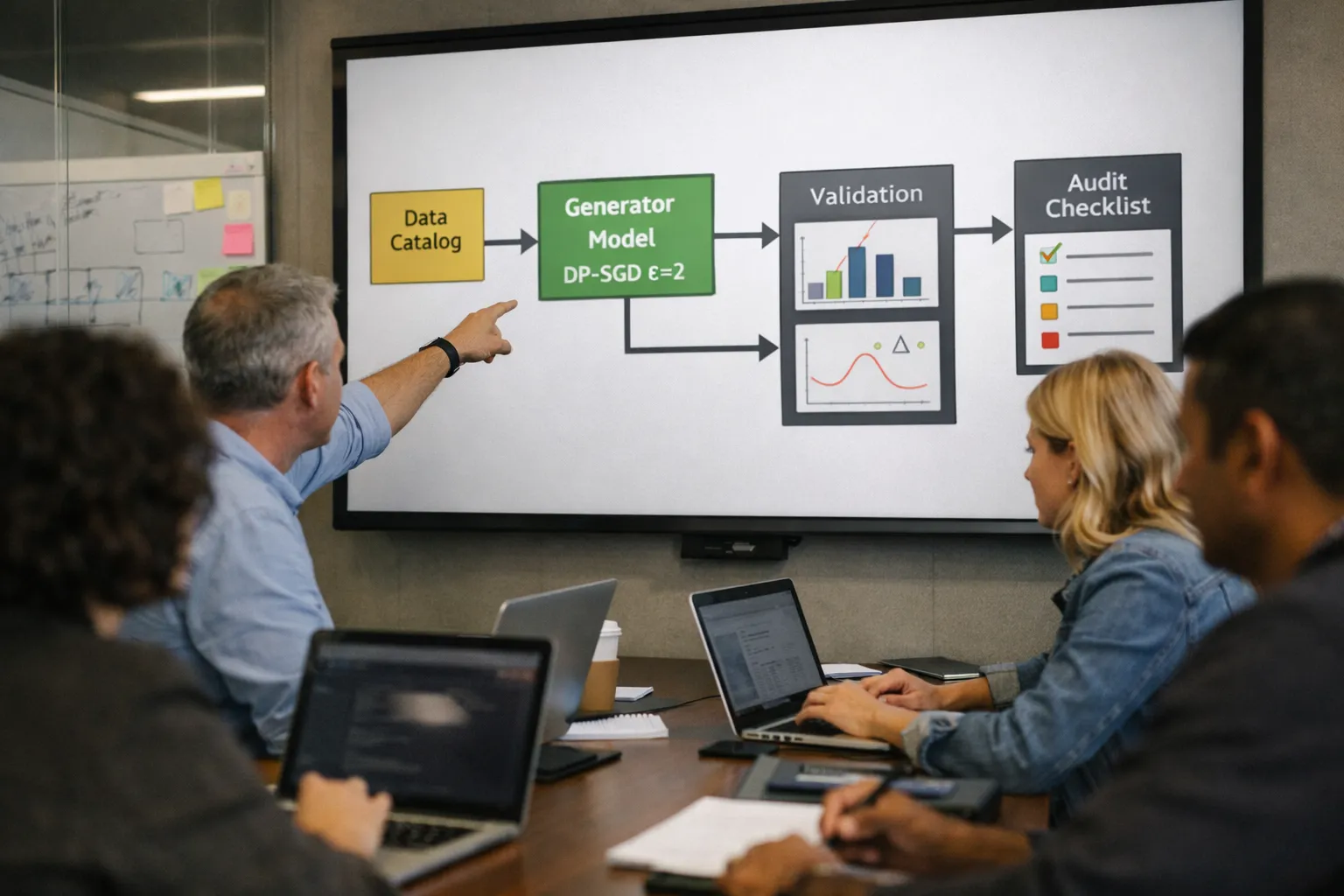
Enterprises in 2026 increasingly use synthetic data to accelerate model development, enable safe data sharing and reduce compliance friction. But synthetic data is not a plug‑and‑play cure: without deliberate design and testing it can leak subject information, degrade downstream model performance or fail regulatory scrutiny. This guide walks AI for‑business teams through a concrete, operational process to design, build and run synthetic‑data pipelines that balance utility, privacy and auditability.
Why a formal synthetic‑data pipeline?
Synthetic data can shorten data access timelines, support cross‑team testing and de‑risk sharing with partners. However, regulatory regimes (GDPR enforcement in the EU, sector rules like HIPAA in the U.S., and tightening state privacy laws), plus enterprise risk policies, now require documented privacy controls, demonstrable risk testing and reproducible lineage. A formal pipeline codifies choice points—what to synthesize, how to protect it, how to measure value and how to show evidence to auditors.
Overview: the 8‑step operational playbook
- Set goals and risk appetite
- Inventory and classify data
- Choose generation method and vendor vs open source
- Configure privacy controls (differential privacy, transformations)
- Validate utility with quantitative tests
- Perform adversarial re‑identification and disclosure testing
- Deploy, catalog and integrate into MLOps
- Monitor for utility and privacy drift; retain audit artifacts
Step 1 — Define goals, use cases and risk appetite
Start by being precise about what the synthetic data must achieve. Common goals include:
- Unit and integration testing for data pipelines and product features
- Training and validation of ML models (fraud, churn, clinical prediction)
- Safe data sharing with external vendors or partners
- Providing anonymized developer sandboxes
For each use case assign success metrics (e.g., delta in model AUC ≤ 2%, coverage of rare classes ≥ X%) and a regulatory/reputational risk class (low/medium/high). The risk class will drive privacy control choices and the level of independent testing required.
Step 2 — Inventory, classify and prepare your source data
Perform a dataset inventory and classification that captures:
- Schema and cardinality of fields
- Sensitivity labels: direct identifiers (SSNs, account numbers), quasi‑identifiers (DOB, ZIP), high‑risk attributes (health, financial amounts)
- Downstream uses: which ML tasks rely on which features
- External linkage surfaces: what public or partner datasets could be used to link records
Produce a minimal "synthesis spec" that lists which fields must be preserved, which can be dropped or coarsened, and which require strict privacy protection. Use this spec to estimate synthetic dataset size, schema, and generation complexity (tabular, time‑series, text, images or multimodal).
Step 3 — Select a generation approach
Options include vendor managed platforms, vendor libraries, or open‑source generators integrated into your stack. Selection depends on use case, scale, and auditability:
- Vendor platforms (commercial synthetic data providers) often provide turnkey privacy controls, compliance documentation and support. Evaluate third‑party audit reports and SLAs.
- Open‑source tools (CTGAN, TimeGAN, SDV family for tabular/time‑series) give full control but require in‑house expertise to harden and test.
- For text and images, foundation models (2026 multimodal generators) can create realistic content; however they require careful controls to avoid memorization of training examples.
Make vendor decisions based on: evidence of privacy guarantees, reproducible evaluation tools, ease of integration with your orchestration stack (Airflow/Prefect/Kubernetes), and contractual audit rights.
Step 4 — Apply privacy controls and configure the synthesis workflow
Privacy controls fall into two broad categories: algorithmic privacy (e.g., differential privacy) and policy/transformational controls (masking, coarsening, suppression).
- Differential privacy (DP): Implement DP at model training time (DP‑SGD) where practical, or use post‑processing mechanisms. Typical operational guidance in 2026: choose an epsilon consistent with risk appetite—very strict (ε < 1), balanced (ε ≈ 1–3), permissive (ε > 3). Document the composition of epsilons across pipeline steps. Record the random seeds, privacy accounting logs and algorithm versions for audit.
- Transformations: Apply schema transformations—hashing or tokenization for identifiers, bucketing ages/locations, suppressing rare categories. For time‑series, add controlled jittering while preserving seasonality patterns.
- Hybrid approaches: For high‑risk fields, substitute synthetic surrogates (generated independently), while lower risk fields are reproduced with DP or transformation.
Important: differential privacy reduces disclosure risk but may harm utility; maintain experiments to evaluate this tradeoff (next section).
Step 5 — Validate utility: measurable tests before release
Don't rely on eyeballing distributions. Standardize a reproducible validation suite that includes:
- Statistical similarity: feature marginal distributions (KS test), pairwise correlations, conditional distributions for key cohorts
- Downstream fidelity: train the target model on synthetic data and compare performance to the model trained on real data (AUC/precision/recall differences, calibration)
- Model stability: compare feature importances, SHAP value rank correlations and decision thresholds
- Rare event coverage: verify that low‑frequency classes (fraud types, rare diagnoses) are represented proportionally or via targeted oversampling
- Generation consistency: check deterministic reproducibility (seeded runs) and version‑to‑version deltas
Set pass/fail thresholds in your synthesis spec. For example: "For classification models, synthetic‑trained model AUC must be within 3% of baseline, and top‑10 feature importance ordering Spearman rho > 0.8."
Step 6 — Run adversarial and disclosure testing
Adversarial testing is essential. Practical tests include:
- Membership inference simulations: attempt to detect whether particular training records influenced the synthetic output using membership attack algorithms
- Record linkage attempts: try to link synthetic records to external identifiable datasets (public voter rolls, social media, commercial aggregators) using deterministic and probabilistic matching
- Attribute disclosure checks: determine whether sensitive attributes can be inferred from combinations of synthetic fields
- Pentest by an independent red‑team: contract an external attacker to run a re‑identification assessment under a defined threat model
Failing tests should trigger either stronger DP, additional suppression/coarsening or rejecting that synthetic dataset for the intended use.
Step 7 — Deploy, catalog and make it audit ready
Turn the generation process into a repeatable pipeline:
- Orchestration: schedule generation runs through Airflow/Prefect or your existing CI/CD platform
- Compute & storage: run generation on isolated compute with encrypted storage; store synthetic artifacts separately from production raw data
- Cataloging & lineage: register synthetic datasets in your data catalog (Alation/Collibra or internal), including metadata: synthesis spec, privacy parameters (ε), validation reports and test results
- Access controls: grant access via role‑based controls and provide ephemeral credentials for short‑term sandbox use
- Documentation: generate a synthesis report (model card) that lists methodology, hyperparameters, privacy accounting, validation artifacts and contact points
These artifacts form the evidence package for legal, compliance and external audits.
Step 8 — Monitor, maintain and govern
After release, monitor both utility and privacy signals:
- Utility drift: periodic re‑runs of downstream model comparisons to detect degradation
- Privacy drift: rerun adversarial tests if the threat landscape changes or new external data sources emerge
- Versioning: assign dataset versions tied to generator code, hyperparameters and privacy logs
- Retention & disposal: define retention windows for synthetic artifacts and logs consistent with your data governance
Schedule periodic DPIAs or equivalent internal risk reviews especially if synthetic datasets are used for high‑risk decisions as defined under relevant laws (for example, the EU AI Act’s "high‑risk" classification for certain automated systems).
Practical checklist for first production run
- Have a documented synthesis spec with risk class and success metrics
- Completed field‑level sensitivity mapping and transformations
- Chosen generator with version and privacy guarantees recorded
- Privacy configuration logged (DP epsilon, mechanisms, seeds)
- Automated validation tests in CI, with pass/fail thresholds
- Executed adversarial tests and documented mitigations
- Registered dataset and artifacts in catalog with access controls
- Auditable generation logs retained for the required window
Example scenario (operationalized)
Consider an insurer that needs synthetic claims data for a new fraud model. The team defines a medium‑risk use case: model training with AUC parity within 2–3%. They inventory 24 months of claims, mark PII and quasi‑identifiers, and elect a hybrid approach: an open‑source CTGAN variant for tabular structure with DP‑SGD (ε ≈ 2) applied at model training time, plus bucketing of postcode fields. The pipeline executes in Kubernetes, generates a synthetic dataset, and runs the validation suite. Downstream model performance on synthetic data shows AUC delta of 1.5% and feature importance Spearman rho of 0.85; adversarial testing finds negligible membership risk. The artifact package (synthesis spec, privacy accounting, validation and red‑team report) is archived in the catalog and used to justify production use.
Commercial & legal considerations
If using a vendor, ensure contractual clauses that permit independent audits, define privacy responsibilities and require prompt notification of vulnerabilities. For regulated industries, include synthetic‑data usage in model risk management documentation and, where required, submit DPIAs to data protection authorities or include synthesis artifacts in conformity assessments.
Final recommendations
Synthetic data is powerful but requires engineering rigor and governance to be safe and useful. Start small: pilot a single dataset with clear success metrics, automate your validation and adversarial tests, and codify the pipeline so reproducibility and auditability are first‑class. In 2026, board‑level attention to data governance means synthetic‑data programs that can demonstrate repeatable privacy controls and validation will scale fastest across enterprise AI initiatives.