
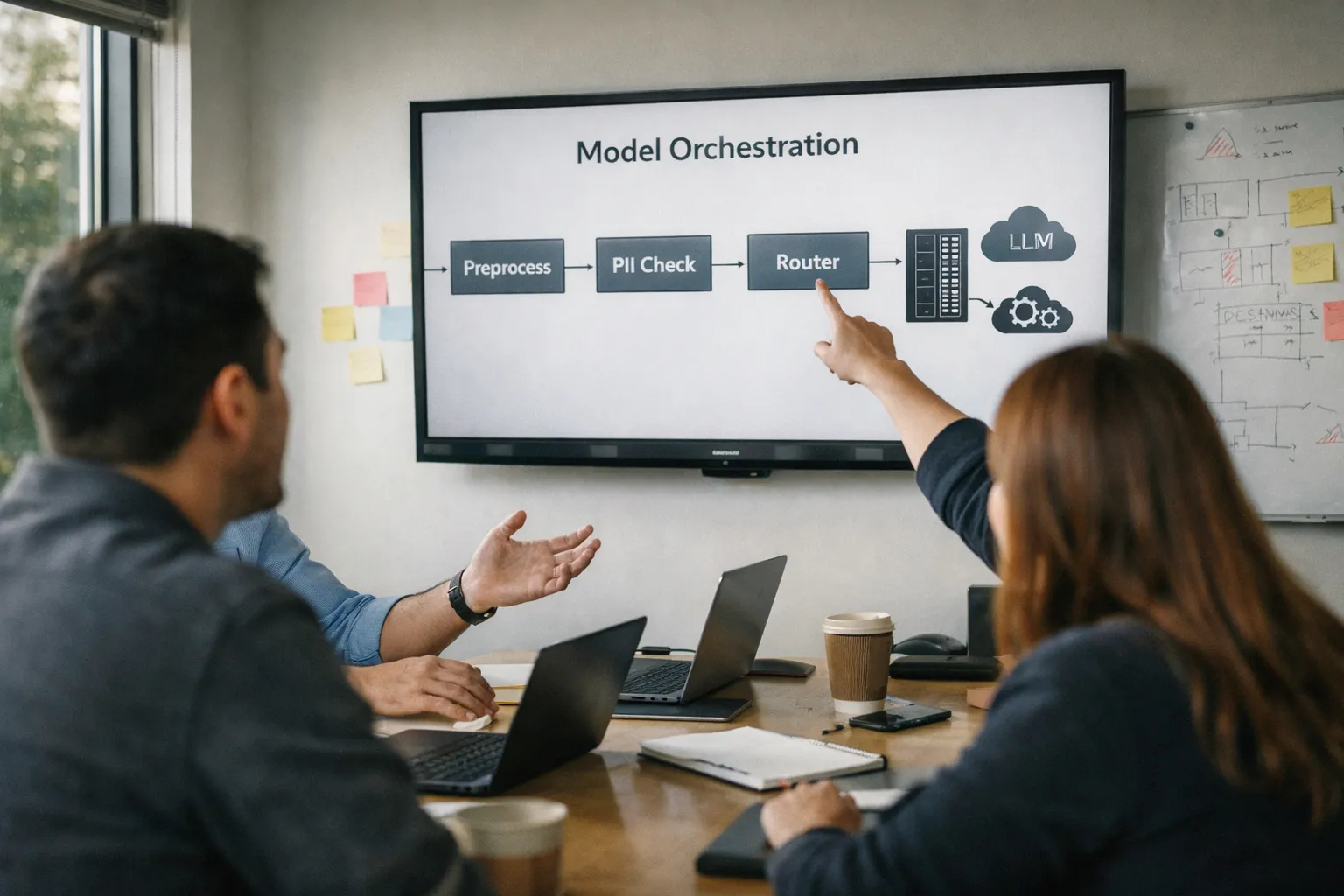
What you'll learn: how to design and implement a model‑orchestration layer in August 2026 that balances cost, latency, privacy and quality; when it pays to build one now; and concrete, measurable steps to prove ROI. This is written for engineering leads, AI product managers and IT decision‑makers who must justify production AI spend and maintain governance.
Since the article's first run in mid‑2026, three practical shifts have continued to change the orchestration calculus: broader adoption of heavily quantized open models and purpose‑built accelerators that push local inference costs down; expansion of managed inference and orchestration services from cloud and niche vendors; and clearer regulatory expectations (provenance, watermarking and auditable model selection) that increasingly demand centralized routing and logging. This update explains what to change in your architecture, what new checks to add, and how to evaluate ROI today.
Prerequisites / Context
Before you build orchestration, confirm you have:
- At least two inference backends (for example, a cloud-grade LLM and a local or edge model). Orchestration rarely returns value with just one homogeneous backend.
- Instrumentation and logs for existing inference calls so you can measure baseline cost, latency and error rates (token counts, response time p50/p95, quality labels).
- Defined risk classes for queries (privacy-sensitive, compliance-bound, financial/legal high‑impact outputs).
- Access to a versioned config store and CI/CD that supports controlled rollout and rollback of routing rules.
- Stakeholder agreement on KPIs that matter to finance, product and legal (cost per resolved case, latency SLA, safety incidents per 10k responses).
Why a model‑orchestration layer still matters in August 2026
- Cost control with real options: Quantized open models (4‑8bit) now make high‑quality local inference feasible on commodity servers and purpose‑built inference accelerators. Routing routine traffic locally or to rules can materially cut recurring cloud charges—if you include hardware amortization and ops in the math.
- Latency and UX: For interactive UIs, agents and voice, local inference and sidecar routing still deliver p95 latency that cloud-only deployments struggle to match without expensive edge GPUs.
- Regulatory & auditability: Regulators and compliance teams now expect auditable model provenance: which model, which dataset or index, and what consent/residency rule applied. Centralized routing is the simplest place to capture and store that evidence consistently.
- Quality & safety: Orchestration lets you direct high‑risk queries into retrieval‑augmented verification flows, deterministic extractors, or human review while keeping low‑risk interactions on cheaper paths—reducing hallucination exposure overall.
- Operational resilience: Hybrid routing reduces single‑vendor reliance; if a cloud vendor has a regional outage, you can degrade gracefully to cached responses, local models, or mode‑restricted UX rather than failing silently.
New trends and realities in 2026 you need to factor in
- Managed orchestration offerings: Several vendors now sell "orchestration as a service" that pairs policy engines, provenance logs and connectors to popular model registries. These accelerate delivery but do not remove the need to validate cost math for your workloads.
- Confidential compute & TEEs: Confidential compute enclaves are increasingly available for on‑prem or cloud inference, letting you meet stricter residency or IP protection requirements without full isolation—but they add hardware and latency costs you must measure.
- Vector DB cost and egress: Index lookups and vector DB egress have become a non‑trivial part of inference cost in many deployments; factor retrieval cost and SLAs into routing decisions.
- Provenance & watermark standards: Growing expectations for model cards, signed provenance headers, and watermarking of synthetic outputs mean your router must capture model identity and any watermark metadata for downstream audits.
When to build one (updated triggers for Aug 2026)
Consider orchestration when any apply to your context:
- You operate hybrid compute (cloud + on‑prem + edge) or must meet residency constraints.
- Your cloud LLM inference bill is a material, recurring operating expense and you want predictable reductions.
- Your application handles regulated data or is classified "high‑risk" by internal/external policy.
- You need single‑pane observability that ties model selection to dollars and legal audit trails.
- You require rapid vendor swap ability for cost or capability reasons (bye‑bye vendor lock‑in).
Core design principles (ROI‑first)
- Policy as data, not code: Keep routing rules in a versioned policy store (Git + policy‑as‑code tools like OPA if you use them). Stakeholders should review policy diffs before rollout.
- Make routing decisions deterministic and stateless: Stateless decisions are easier to audit and replay; record the inputs used to make each decision to enable cost/quality analysis later.
- Privacy and residency first: Enforce redaction and residency rules before any external calls. Consider confidential compute where redaction would remove essential context.
- Cost‑aware fallbacks: Define cost budgets per user tier or workflow and surface expected cost impacts in observability—don’t allow hidden cost regressions from rule changes.
- Instrument for attribution: Log model name/version, token counts, retrieval sources, embedding index version and cost estimate so finance can do chargebacks accurately.
Routing decision matrix — updated signals
Score each request across these dimensions, weight them according to business priorities, and map score ranges to backends:
- Complexity / risk: Legal/medical/financial keywords, multi‑step reasoning or output publishability.
- Privacy / PII / residency: Regulated identifiers or jurisdictional constraints that force on‑prem handling.
- Latency tolerance: Voice or interactive UI vs. batch analytics.
- Cost sensitivity: Bulk low‑value queries (e.g., sentiment) are cheap routing candidates.
- Retrieval dependence & egress cost: If an answer requires expensive index lookups or live inventory, prefer a backend co‑located with that data.
- Verification need: Require retrieval‑augmented verification, ensemble agreement, or human review when hallucination is unacceptable.
Practical routing rule example
- If regulated PII detected → redact, require confidential‑compute on‑prem inference or synchronous human review if redaction loses key context.
- Else if simple lookup and token request < 150 → rules, cache or local small model.
- Else if publishable legal/financial output → enterprise cloud LLM with retrieval + human sign‑off and retention of provenance metadata.
- Else → mid‑tier cloud LLM with verification checks and 24‑hour cache for idempotent queries.
Architecture patterns that matter in 2026
1. Centralized Router with Policy Store
Best when governance and consistent billing matter. The router is stateless and consults a versioned policy store; telemetry feeds back to a cost/quality dashboard.
2. Sidecar Router for Low Latency
Sidecars remain essential for interactive services. They should keep a local policy cache and a lightweight model inventory to avoid extra RTT.
3. Edge/Hybrid Router with Local Serving
Edge routers now commonly serve quantized models on small servers or inference accelerators, producing initial answers locally and escalating to cloud for depth. Useful when latency and data residency both matter.
4. Managed Orchestration + Vendor Connectors
If you lack bandwidth, managed orchestration offerings speed time‑to‑value. But you still must validate cost, logging completeness, and ability to prove provenance to auditors.
Implementation steps — concrete, numbered
- Inventory backends and true costs: Catalog cloud LLMs, on‑prem models (quantized sizes, CPU/GPU/accelerator footprint), vector DB costs and rules engines. Track prompt+completion token price, amortized infra cost per 1k tokens, retrieval egress per query, and ops hours for model maintenance. Example: compute amortized on‑prem cost as (hardware depreciation + power + operator hours)/monthly usable tokens.
- Define routing signals with cheap classifiers: Build lightweight preprocessors that extract intent, PII flags, token estimate, domain tags, user tier and retrieval dependency. Use deterministic checks and small classifiers to avoid noisy oscillation.
- Design scoring, thresholds & budget controls: Implement a weighted scoring function stored in GitOps so product, legal and finance can review. Add per‑tenant or per‑feature cost budgets that can be enforced by the router.
- Implement timeouts, fallbacks & cost safety nets: Set per‑backend timeouts (e.g., 150–300 ms for local, 1–3s for cloud mid‑tier, 4–8s for premium) and explicit fallback UX. Prevent cascading retries by using request IDs and circuit breakers.
- Add verification & provenance: Attach retrieval proofs, log model/version and watermark metadata. Include lightweight hallucination detectors (ensemble disagreement, calibration checks) and human‑review hooks for high‑risk outputs.
- Cache and tune: Cache idempotent responses and embeddings; monitor cache‑hit rate, retrieval cost saved per hit and rollback windows for stale cache problems.
- Attribution, billing & dashboards: Log token counts, model version, retrieval source and estimated cost per request. Expose dashboards that map model usage to dollars and safety events for finance and compliance.
- Canary, replay & iterate: Replay historical traffic against new rules with a "what‑if" simulator and canary changes on a small traffic fraction. Measure cost delta, quality delta and safety incidents before full rollout.
Observability & KPIs — updated metrics to track
Minimum per‑request logging:
- Routing inputs and final decision
- Backend chosen, model name/version, and any confidential compute flag
- Token counts (prompt + completion), response latency (p50/p95), and estimated cost
- Retrieval sources, embedding index version and cache hit
- Safety checks, watermark/provenance metadata and human‑review outcomes
Monthly KPIs to tie to finance and product SLAs: average cost per resolved case, percent traffic on premium models, cache‑hit rate, retrieval precision@N, safety incidents per 10k responses, model‑drift alerts and mean time to rollback for policy changes. These metrics make routing changes defensible to auditors and CFOs.
Operational & governance considerations (ROI lens)
- Policy governance: Treat routing rules as policy artifacts. Require cross‑functional review for changes impacting cost or data residency.
- Privacy & audit: Redact before external calls. Maintain signed provenance headers and retention records. Make logs queryable for legal discovery.
- Vendor outages: Define degraded modes and communicate tradeoffs rather than silently switching to lower‑quality backends.
- Security: Use short‑lived credentials, encrypted logs for PII, and purge sensitive logs per retention policy; consider confidential compute where auditability and IP protection demand it.
- Human‑in‑the‑loop: Keep small, SLA‑backed review teams for high‑risk outputs and instrument reviewer decisions for model retraining.
Real‑world examples & cost perspective (fresh August 2026 cases)
Health‑tech triage chatbot
Pattern: intent + clinical flagging → local clinician‑tuned quantized model for routine triage → premium cloud model + clinician review for red flags. Outcome: the team moved routine triage locally and used confidential compute for flagged cases—reducing cloud spend for clinical queries while meeting stricter audit trails and consent capture. Break‑even was reached after accounting for a dedicated on‑prem inference node and 0.5 FTE of ops work for model updates.
Retail personalization at scale
Pattern: deterministic rules and caching for common product recommendations → local lightweight embedding model for session personalization → cloud LLM for long‑form marketing copy and campaign generation. Outcome: routing reduced expensive cloud calls during peak traffic and bounded vector DB egress costs by co‑locating retrieval with local inference.
Government customer service
Pattern: on‑prem models running in confidential compute for citizen data; cloud fallbacks only for non‑sensitive public information. Outcome: orchestration enabled clear residency guarantees and a single audit trail tying each response to a model version and reviewer, which eased compliance reviews.
Common mistakes to avoid
- Not measuring baseline costs and traffic mix before building orchestration—without this you can't demonstrate ROI.
- Routing on noisy signals—avoid brittle NLU classifiers that cause oscillation in routing and increase ops load.
- Underestimating ops cost of local models—include engineering time, monitoring and hardware amortization in your ROI calculations.
- Failing to version routing rules—policy diffs and easy rollback are essential for audits and incident response.
- Assuming a one‑size‑fits‑all policy—different user tiers and workflows justify different tradeoffs between cost and quality.
Pro tips
- Start with a single vertical and one measurable KPI (e.g., reduce cloud inference spend for support chat by X% in 90 days). Treat orchestration as a product experiment.
- Build a traffic‑replay "what‑if" simulator that replays historical logs against new routing rules and reports estimated cost and quality deltas.
- Keep a compact human‑review team with SLAs; compliance teams prefer measurable human oversight to all‑or‑nothing automation.
- Version embedding indexes and include index version in logs so you can reproduce answers for audits and retraining.
- Negotiate vendor SLAs that include provenance headers and watermarking capabilities; do not rely on marketing claims alone.
Checklist before production
- Model inventory with documented capabilities and total cost model
- Routing signals and scoring function implemented and versioned
- Centralized config store with approvals and canary rollout support
- Timeouts, deterministic fallbacks and human escalation paths
- Attribution logging (token counts, model, cost estimate, provenance)
- Redaction, consent capture and audit logs in place
- Canary tests and rollback procedures validated using historical replay
Practical roadmap — short timeline
- Run a 4‑week pilot for a single use case (support chat, triage or FAQ). Measure cost per session, latency percentiles and safety incidents.
- Use a traffic‑replay simulator to test routing thresholds and estimate cost impact at scale.
- Map stakeholders (product, legal, finance) and agree on threshold change processes; require policy diffs for sign‑off.
- Invest in an observability dashboard that ties model usage to dollars and to safety events; iterate using canary rollouts.
FAQ
How much can orchestration realistically save our cloud spend?
Savings vary by workload and how thorough your ROI includes ops and infra costs. Industry case studies and pilots typically show meaningful savings—often in the 20–60% range—for organizations that route high‑volume, low‑complexity traffic to local models or rules. Don’t assume savings: run a 30‑day traffic replay including hardware amortization and maintenance to estimate break‑even for your situation.
Is maintaining local models worth the engineering overhead?
Sometimes. It’s worth it when you have high volume of low‑complexity queries, strict latency targets, or data residency requirements. Calculate true break‑even: amortized hardware + operator time + monitoring vs. expected cloud spend reduction. If you have limited engineering bandwidth, start with rules, caching and sidecar inference before investing in full on‑prem model infra.
How do we prove routing decisions to auditors and regulators?
Log the routing inputs, chosen backend, model version, token counts, redaction actions and provenance metadata. Keep policy changes in version control with required approvals. For high‑risk outputs, retain human review records. These practices align with current expectations for auditable model provenance and accountability.
Can orchestration reduce hallucinations?
Yes—when orchestration routes high‑risk queries to retrieval‑augmented flows, deterministic extractors or human review, you reduce hallucination risk. But orchestration is a control plane, not a fix: invest in retrieval quality, verification checks, ensemble agreement and robust human oversight for the highest‑impact cases.
What's the quickest way to get value without a big upfront investment?
Route the top X% of traffic by volume and low complexity to cached responses or deterministic rules. Use traffic replay to validate thresholds before expanding. That gives an early, measurable reduction in cloud spend and the data needed to justify broader orchestration effort.
Final thought: treat orchestration as product work: define measurable KPIs, validate with replay and canaries, and keep policy changes transparent to finance and compliance. When your routing layer becomes auditable, cost‑aware and reversible, you unlo