
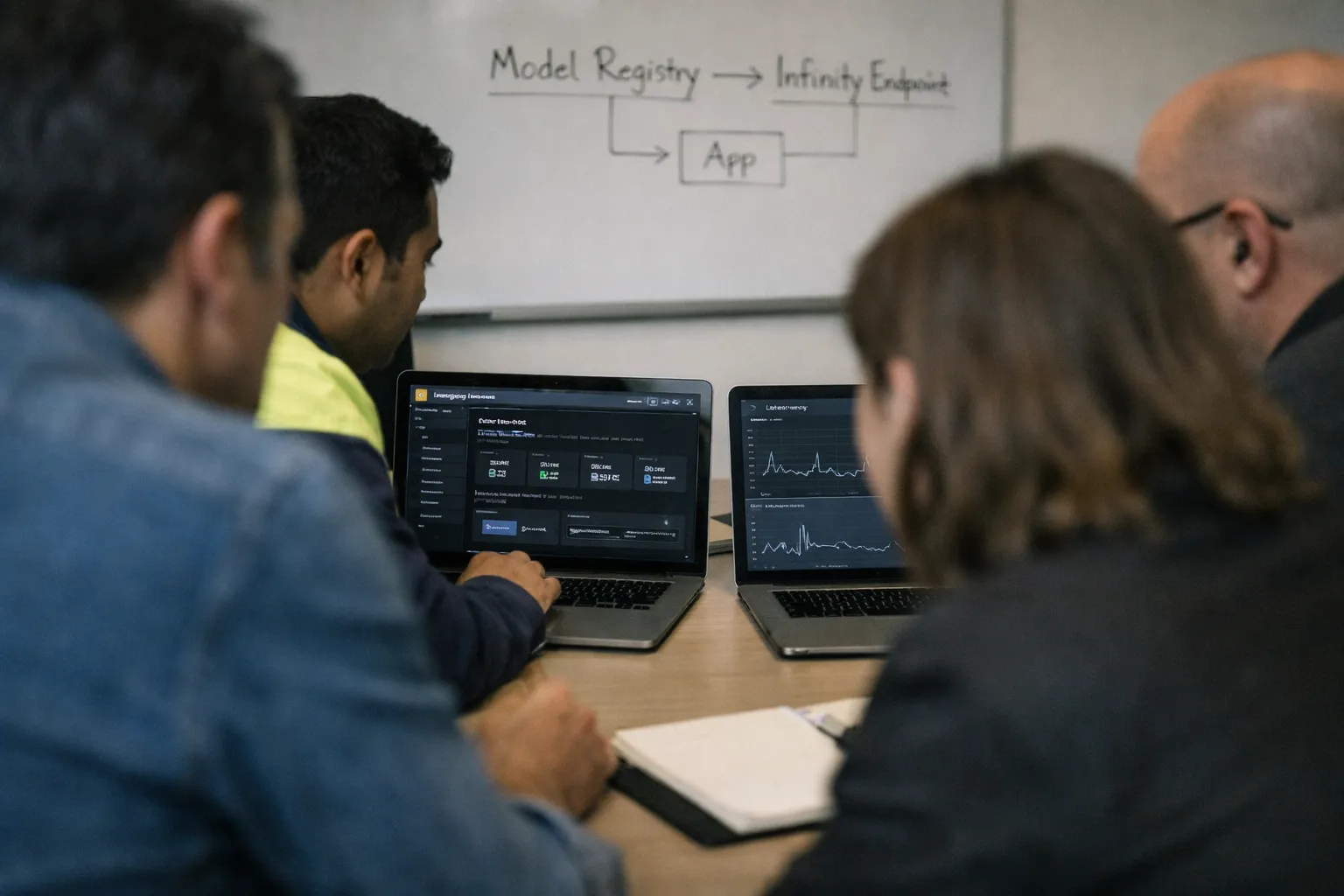
Summary: This August 2026 update evaluates Hugging Face Infinity Enterprise for production LLM inference. It focuses on what enterprise buyers actually need now: in-account deployment guarantees, model provenance and signing, cost controls for mixed workloads, and updated compliance expectations under strengthened AI oversight. If you’re evaluating Infinity this quarter, read the sections on deployment guarantees, cost modelling for hybrid workloads, and the procurement checklist.
What is Hugging Face Infinity Enterprise?
Hugging Face Infinity is the company’s production-focused inference platform for transformer and other LLM families. The enterprise tier packages runtime optimizations, governance primitives tied to the Hugging Face Hub, and deployment topologies that aim to address data residency and auditability. In practice, Infinity functions as a managed inference runtime that connects model registry, optimization pipelines (quantization/compilation), and operational controls (canaries, traffic split, telemetry).
Background: vendor, audience and market context
Hugging Face positions Infinity as the runtime for organizations that already adopt the Hub or want a fast path from model experimentation to production. Since mid‑2026 the market has continued to fragment: many teams now split inference between a centrally managed runtime for higher-risk, audited calls and decentralized, cost-optimized runtimes for lower-risk/latent-tolerant requests (edge or microservices running specialized small models). Procurement treats Infinity less like commodity compute and more like a compliance-enabled managed inference platform: buyers pay for governance, reproducibility and operational SLAs, not just raw GPU hours.
Features analysis — what’s new and what still matters
- Deployment topologies: In‑account, single‑tenant VPC deployments are now the default ask for regulated customers. Vendors commonly provide deployment automation (Terraform/CloudFormation modules) that run Infinity controllers inside customer cloud accounts; insist on a written topology diagram in the contract that lists which services access raw inference data.
- Model provenance & signing: Expect built-in support for signed model artifacts and immutable metadata. Artifact signing and tamper-evident manifests reduce audit friction and are increasingly required by enterprise procurement teams.
- Optimization surface: Infinity continues to expose quantization, compilation (AOT), and multi-device orchestration at deployment time. Newer arrivals in 2026 include automated mixed-precision policies and adaptive batching tuned to request size, which can materially reduce cost for chat-style workloads if validated per model.
- Observability & privacy-aware telemetry: Telemetry hooks to common stacks (Datadog, Splunk, Prometheus) are standard. Recent improvements emphasize redaction and selective retention policies at the telemetry source to meet privacy commitments and reduce exposure in logs.
- Integration with MLOps: Expect out-of-the-box connectors for common model pipelines (MLflow, Git-based CI, and the Hugging Face Hub). Teams now use these connectors to gate deployments with automated risk checks (prompt tests, safety classifiers) as part of CI/CD.
Performance and scalability — practical expectations
Infinity delivers predictable performance for supported model families when you design for the platform. For typical customer-facing chat and classification workloads, configured GPU-backed endpoints commonly achieve p99 latency in the low hundreds of milliseconds with sensible prompt length and tokenization. That remains true in August 2026.
Key caveats:
- Performance varies by model architecture, tokenizer behavior and prompt engineering. Always run production-like load tests—your p99 will change if you switch from 1–2 sentence prompts to long-form generation.
- Hybrid patterns (small local models for routine queries, Infinity for complex or regulated responses) are now a best practice to control cost and risk.
- Use result caching and adaptive batching for high-throughput, similar-request workloads. These are among the most cost-effective levers short of changing model size.
Security, compliance and the regulatory landscape
Regulatory scrutiny of AI systems intensified in 2026. The EU AI Act and sector regulators have focused on documentation, risk assessments and human oversight for high‑risk models. In the U.S., guidance from financial and health regulators has emphasized explainability, recordkeeping and incident reporting for models that affect customers materially.
The law requires data controllers to implement appropriate technical and organizational measures. Practically, in procurement you must:
- Document full data flows into and out of Infinity endpoints, including telemetry routes.
- Obtain a clear Data Processing Agreement (DPA) that specifies controllers/processors and data residency for backups, logs and model artifacts.
- Verify encryption at rest and in transit, and require artifact signing and key management protocols if your compliance posture demands it.
- Secure written rights for audits, breach notifications (timelines) and forensic output where required by sector rules.
If you handle regulated data, insist on in-account deployment or an isolated tenancy and test the deployment automation during pilot runs—don’t accept verbal commitments about data residency.
Observability, operations and SRE realities
Infinity provides platform-level telemetry, but you remain responsible for application-layer observability. Instrument prompt and response sampling, implement drift detection (data and concept), and maintain a rollback-ready immutable bundle in your artifact store. Use canary traffic and staged rollouts; validate cost and latency under the precise concurrency and prompt distributions your application will see.
Costs and pricing considerations (updated)
Infinity Enterprise is sold via enterprise agreements combining fixed management fees, resource consumption (CPU/GPU time, memory), and storage/data transfer. In 2026 vendors increasingly offer hybrid pricing models: committed reserved capacity for baseline workloads plus overage per‑inference pricing for burst traffic. Negotiate the following explicitly:
- Written rates for each endpoint type and model family you plan to run, including an example TCO for your expected token profile.
- Overage terms and how burst capacity is billed during autoscaling events.
- Discounts for reserved capacity and for multi-year commitments, with break clauses tied to regulatory or performance failures.
Budget model: estimate average tokens/request × RPS to get token throughput, map to endpoint shapes, then layer fixed management fees and storage. For many organizations a two-tier architecture (small local models + Infinity for audited calls) reduces spend 30–60% versus running all traffic through a single enterprise endpoint.
Representative commercial guidance: pilots still start at low five-figures for small proofs; production contracts for multi-line deployments commonly move into mid-six-figures to low-seven-figures annually depending on throughput and SLAs. Get written pricing scenarios for steady-state, 2x peak and 5x worst‑case before signing.
Pros and cons (at a glance)
- Pros: Integrated Hub-to-runtime workflow, artifact signing and provenance, in-account deployment automation, and richer privacy-aware telemetry controls that speed audits.
- Cons: Managed-service premium vs full self-hosting; not a solution for fully air-gapped on-premises appliances without specific contractual commitments; per-model validation work remains significant.
- Neutral: Performance is strong for supported models, but absolute latency and throughput require workload-specific benchmarking and prompt-level optimization.
Who it's for
Infinity Enterprise is a strong choice when:
- Your model lifecycle uses the Hugging Face Hub and you want a governed, auditable path to production.
- You require enterprise controls (SSO, RBAC, private networking) and prefer to outsource inference ops while retaining governance.
- You need vendor-managed optimizations plus contractual compliance guarantees for regulated workloads.
It is less suitable when:
- You require complete air-gapped, on-premises-only operation with no vendor-managed cloud presence—verify exact contract guarantees.
- Your priority is absolute lowest-cost inference and you have the SRE resources to run an optimized, bespoke, self-hosted stack.
Alternatives to consider
- Cloud provider inference services (AWS Bedrock, Google Vertex AI, Azure OpenAI) for deeper cloud integration and region-specific compliance features.
- Self-hosted runtimes (NVIDIA Triton, KServe, custom Kubernetes clusters) when you need maximal runtime control and minimal vendor lock-in.
- Specialist inference providers that offer proprietary accelerators or edge appliances if latency and unique hardware are your primary constraint.
Your rights and procurement checklist
Your rights: In negotiation you have the right to demand: a clear DPA that details processing locations and subprocessors; security certifications relevant to your scope (SOC 2, ISO 27001 or equivalents); artifact-signing practices; and contractual audit rights, incident notification timelines and SLAs. If you process EU personal data, the law requires you to ensure lawful transfer mechanisms and documented technical measures.
Procurement checklist (next steps to protect your organization):
- Run a scoped PoC using production-like traffic and token profiles—capture p50/p95/p99 latency, error rates and token throughput under sustained load.
- Obtain a written deployment topology that maps which components run in your cloud account, which are vendor-managed, and where logs/telemetry are stored.
- Demand DPA, security certifications, artifact-signing details, and SLA/penalty terms in redline-ready contract form.
- Model costs for steady-state, 2x peak bursts and worst-case scale; negotiate reserved capacity or commit/discounts tied to measured metrics.
- Engage legal and compliance early to map your use case to applicable AI rules (EU AI Act, sectoral guidance). If regulated data is involved, require in-account deployment and test it during the pilot.
Verdict
Hugging Face Infinity Enterprise is a pragmatic, compliance-minded runtime in August 2026 for organizations that value a Hub-integrated path to production and need governance primitives that auditors expect. The platform reduces build time and shifts operational burden to the vendor, at a premium. Do a time-boxed pilot with in-account deployment, insist on written processing guarantees, validate performance with realistic loads, and model three cost scenarios before committing to multi-year contracts.
FAQ — Common enterprise questions
Can Infinity run inside our cloud account so we retain control of data?
Yes—enterprise agreements commonly include options to deploy controllers and inference endpoints inside customer-managed cloud accounts or private VPCs. Insist on a written topology diagram that specifies what runs in your account, where logs are stored, and which services the vendor can access.
How should we benchmark latency and cost for chat-style workloads?
Simulate realistic prompts and concurrency, capture token counts, and measure p50/p95/p99 latency and throughput. Map those metrics to recommended endpoint types and request vendor TCO examples for those instance shapes. Include application-level caching, smaller specialist models for routine queries, and result caching in your cost model.
What compliance artifacts should we demand before productionizing?
At minimum: a DPA, relevant security certifications (SOC 2/ISO 27001 or equivalent), encryption guarantees, artifact signing procedures, incident response timelines, and explicit data residency commitments. For regulated sectors add audit rights and right-to-audit clauses.
Do we still need application-level logging and drift detection?
Yes. Infinity supplies platform telemetry, but you must instrument prompts, sample responses, and implement drift and quality monitoring to detect model degeneration or data shifts. Treat platform telemetry as necessary but not sufficient for model governance.
Next steps: Start with a scoped pilot that includes legal review of processing terms and a production-like load test. Involve security and compliance early—if your deployment will process regulated data, require in-account deployment and proof during the pilot. For contract language and regulatory interpretation, consult a qualified attorney.