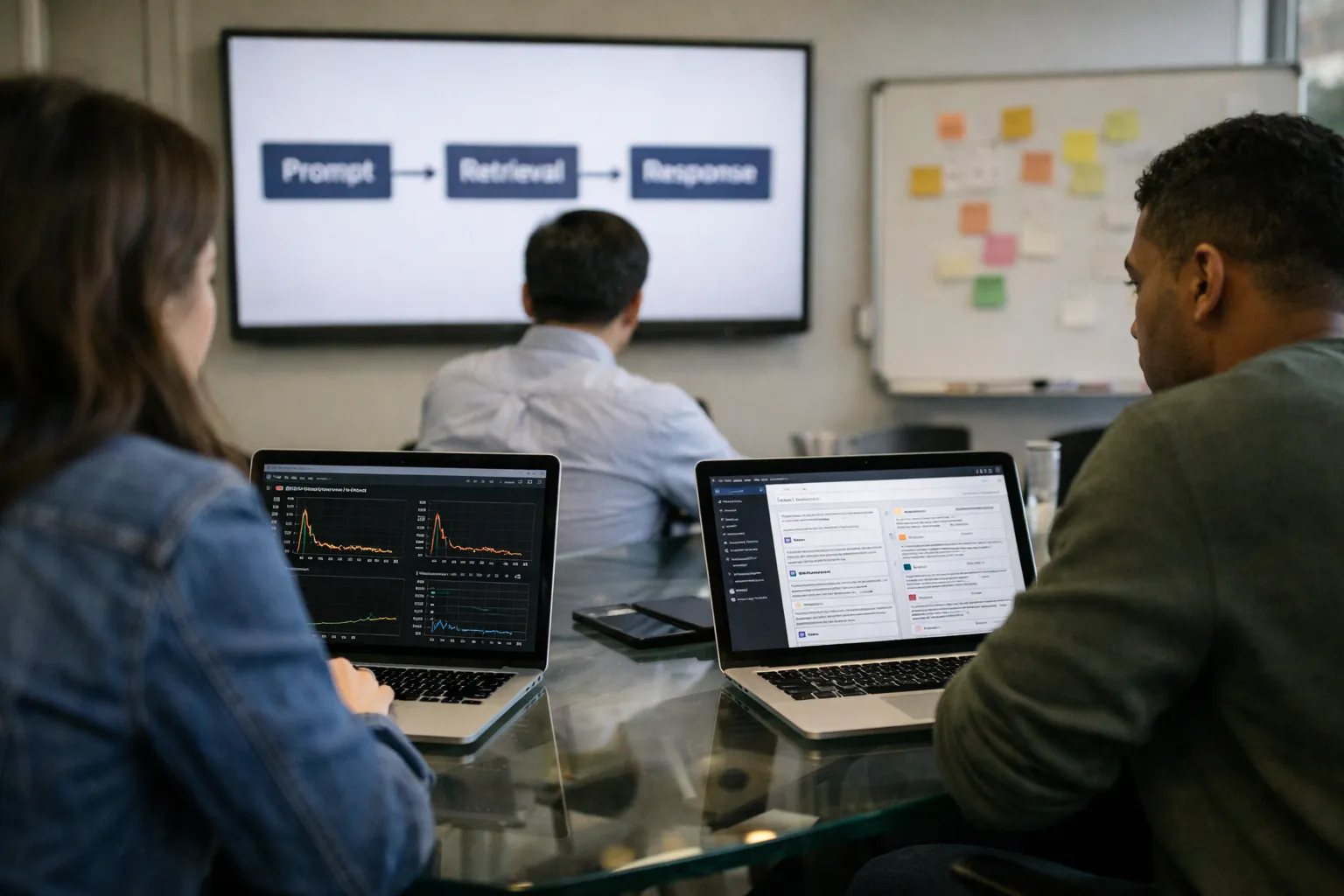
Date: June 2026. For AI Business Solutions readers exploring how to verticalize large language models (LLMs) for real business workflows, the choice between fine‑tuning, advanced prompting and retrieval‑augmented generation (RAG) is now primarily an economics and risk‑management decision. This article compares those approaches across cost, latency, governance, accuracy, time‑to‑market and long‑term maintenance, with concrete guidance for CIOs, ML engineers and product managers.
Why this comparison matters in 2026
Over the past two years, three trends reshaped enterprise choices: (1) foundation models have become modular (LoRA/adapters, instruction‑tuned variants), (2) managed services for embeddings and vector stores matured, and (3) regulatory scrutiny (privacy and transparency) pushed firms to treat model outputs as auditable business artifacts. Together these factors make verticalization strategy the single largest determinant of LLM program TCO and operational risk.
What we’re comparing
- Fine‑tuning: updating model weights (full or low‑rank methods like LoRA/adapter layers) on domain data so the model internalizes vertical knowledge.
- Prompt engineering + system prompting: hand‑crafted templates, chains of thought scaffolding, and prompt libraries that shape model behavior at inference time without changing weights.
- Retrieval‑Augmented Generation (RAG): pairing models with external knowledge stores (embeddings + vector DBs, plus retrieval pipelines) so responses anchor to curated documents.
Key variables that determine the right choice
- Vertical complexity: degree to which the domain requires procedural knowledge, narrow taxonomy, or precise numeric/financial/legal accuracy.
- Data sensitivity: PII/IP restrictions, residency requirements, and auditability obligations.
- Scale and concurrency: expected queries per second and acceptable latencies for users.
- Maintenance capacity: teams available for labeling, retraining, validating and monitoring.
- Time-to-market: how quickly a usable product must reach customers.
Comparative analysis
1) Cost (one-time and ongoing)
Fine‑tuning carries higher upfront compute and labeling costs. Full‑model tuning for a large foundation model can require days on multi‑GPU clusters; even low‑rank adaptation like LoRA needs compute and hyperparameter tuning. Upfront costs include data cleaning, annotation, validation and legal review.
Prompt engineering is cheapest to start: no model retraining and costs are limited to prompt design, testing, and orchestration. Ongoing costs are primarily inference (token usage) and maintenance of prompt repositories.
RAG adds storage and retrieval costs: vector DB hosting, embedding generation, and document ingestion pipelines. Embedding generation is a recurring cost for new content; vector store charges (hosted or self‑managed) add predictable monthly spend tied to storage and query throughput.
- Example profile — medium enterprise legal assistant (pilot):
- Prompt engineering: minimal infra; pilot cost often $50k (engineering + UX + cloud inference) in first 3–6 months.
- LoRA/adapter tuning: additional upfront compute and annotation: pilot can range $75k–$250k depending on model size and label effort.
- RAG: embedding and vector store costs add predictable op-ex ($1k–$10k/month for medium volume) plus initial ingestion work.
2) Accuracy and domain fidelity
Fine‑tuning yields the highest recall of domain‑specific phrasing and conventions because knowledge is internalized. For use cases needing consistent brand voice, complex legal reasoning, or workflow automation with deterministic outputs, tuning often outperforms prompt‑only approaches.
Prompt engineering can be surprisingly effective for many front‑end tasks (customer support, sales enablement) where context is available and hallucination tolerance is moderate. However, prompts hit a ceiling: for nuanced, closed‑book facts or procedural correctness, they often underperform.
RAG is the most pragmatic route to factual accuracy at scale when a reliable corpus exists. Because outputs are grounded in documents, RAG reduces hallucination risk and simplifies audit trails — at the cost of retrieval engineering and source management.
3) Latency and user experience
Prompting and fine‑tuned models both incur inference latency; the difference is marginal for cloud‑hosted models. On the other hand, RAG adds retrieval latency and orchestration overhead (embedding lookup, re-ranking, prompt assembly) — though optimized pipelines (caching, nearest‑neighbor indices) routinely bring end‑to‑end latencies into acceptable ranges for many business apps.
For real‑time, sub‑200ms interactions (e.g., live chat on high‑traffic sites), firms often deploy optimized prompt templates on smaller tuned models at the edge or use aggressive caching. Where millisecond responsiveness is non‑negotiable, model size and hosting architecture often drive the decision more than tuning vs RAG.
4) Governance, compliance and data exposure
Fine‑tuning raises governance questions about training data provenance and the permanency of learned artifacts — once weights change, removing a problematic data point is nontrivial. Enterprises dealing with regulated data (financial, healthcare) must invest in rigorous dataset lineage, consent management and retraining policies.
Prompt-only approaches keep data external to the model, which simplifies some compliance pathways because the foundation model remains unchanged. RAG, however, offers strong auditability: outputs can be traced back to source documents used in the retrieval step, which aligns with many regulatory transparency requirements.
5) Maintenance and model drift
Fine‑tuned models can drift as external facts change — they require retraining or incremental LoRA updates. That maintenance is an operational cost that grows with the breadth and dynamism of the domain. Prompting demands ongoing prompt library updates but can be less effort to iterate. RAG shifts the maintenance burden toward keeping the knowledge corpus current, which is often easier operationally because documents can be updated independently of the model.
Market and vendor dynamics to watch
- Managed adapter services: Several MLOps vendors (managed platform providers and consulting firms) now sell LoRA/adapter tuning as a service with traceability and rollback — lowering the barrier to tuning for mid‑market customers.
- Vector store specialization: As vector DBs compete on latency and index cost, the operational gap between RAG and direct model tuning shrinks for many teams.
- Regulatory pressure: Transparency rules in jurisdictions implementing AI disclosure/traceability increase the attractiveness of RAG for auditable outputs.
Decision framework — When to choose each approach
- Choose prompt engineering when: you need a fast, low‑cost pilot; the domain is high‑variability or conversational; accuracy requirements are moderate; and the organization lacks ML ops capacity.
- Choose RAG when: you have a curated corpus of documents, require traceability, or need to frequently update knowledge without retraining. RAG is the default for document search, contract analysis, and knowledge‑centric assistants.
- Choose fine‑tuning (LoRA/adapters) when: the domain requires deep internalized knowledge, low variability in documents, strict brand/behavior constraints, or when latency and inference cost improvements from smaller tuned models justify the upfront investment.
Hybrid patterns that are winning in 2026
Most successful deployments blend approaches:
- Start with prompt engineering to validate product‑market fit quickly.
- Layer RAG for factual grounding and auditability as the corpus grows.
- Apply LoRA/adapters selectively to subcomponents that need deterministic behavior (e.g., contract clause classification, domain‑specific entity resolution) while keeping general language behavior controlled by prompts.
Practical checklist for enterprise teams
- Map use cases to the decision framework above (accuracy, latency, data sensitivity).
- Estimate end‑to‑end costs: include annotation, compute for tuning, vector store ops, and governance overhead — not just per‑token API fees.
- Assess auditability and explainability needs; prefer RAG if legal traceability is required.
- Prototype with prompt + RAG as a minimum viable deployment; instrument observability for hallucination, latency and source usage.
- Plan for model lifecycle: data retention policies, retraining cadence, and rollback procedures for tuned weights.
Conclusion
There’s no one‑size‑fits‑all answer. In 2026 the economics favor a staged approach: prompt first, RAG to anchor facts and enable audits, and selective tuning where persistent, high‑value domain behavior justifies the investment. For enterprises, the strategic question is less “which technology wins?” and more “how do we combine these tools to minimize risk while maximizing measurable business outcomes?” Successful teams instrument for outcomes, not for novelty: measure conversion lift, error rates, and legal exposure — then invest where marginal gains beat marginal costs.