
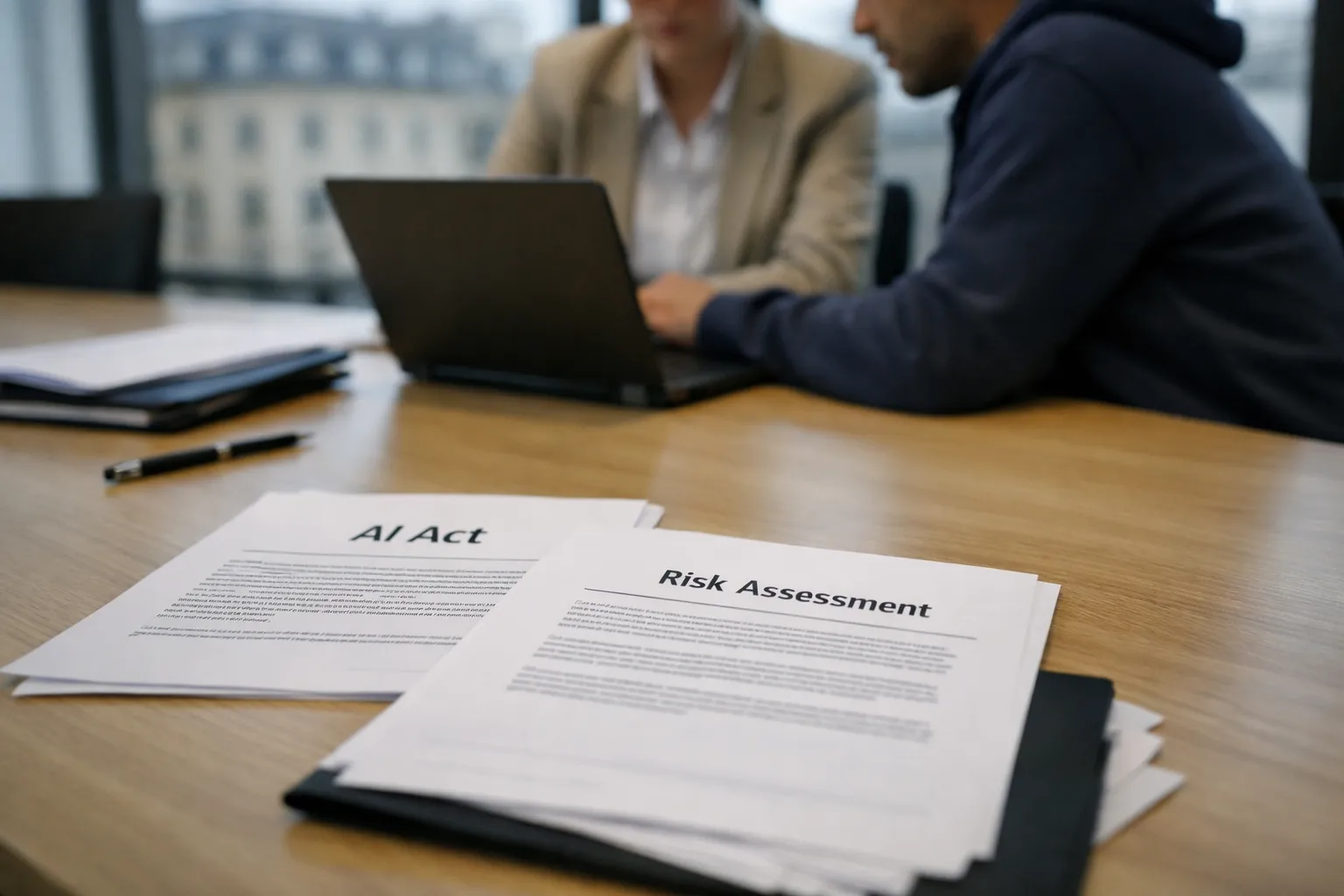
Brussels — June 15, 2026 — If your organization uses artificial intelligence (AI) inside the European Union, you have one non-negotiable date on the calendar: August 2, 2026. That’s when large parts of the EU Artificial Intelligence Act (EU AI Act), adopted in 2024, become operational for many "deployers" — organizations that use AI systems in business processes. Between now and then you must move from plans and PowerPoints to demonstrable controls: inventory, risk classification, data-protection impact assessments (DPIAs), logging, human oversight and contract enforceability.
Context: why June 2026 matters
The law distinguishes providers (who place AI systems on the market) from deployers (who operate them). Most companies are deployers — you don't need to train a model to be in scope. Since March, market behavior hardened: enterprise buyers and procurement teams are demanding auditability; vendors are shipping enterprise features; and internal compliance programs that treated AI like ordinary software are being rewritten to include continuous controls.
In a May–June 2026 poll of 220 European technology leaders conducted by AI Business Solutions, 72% said their procurement teams had added AI-specific clauses in the past three months; 64% reported vendors now offer model-versioning and audit modes as standard in enterprise tiers. Those shifts make June the make-or-break month to convert policies into evidence you can show inspectors.
What’s changed since March
- Vendor features matured. Model cards, change-notification APIs, enterprise audit modes and red-team reports are now common in tiered enterprise offerings.
- Operational expectations hardened. Regulators and buyers want continuous evidence — immutable logs, versioned artifacts and human-oversight trails — not one-off checklists.
- Standards and frameworks are converging. Teams are mapping the EU AI Act controls to the NIST AI Risk Management Framework and emerging ISO/IEC guidance to create interoperable documentation.
Details: what deployers must do now (concrete actions)
If you have two minutes, do this. If you have two weeks, do all of it. Think of this as preparing for an inspector who can ask for records at any time — and will expect machine-readable evidence.
- Build a usable AI inventory (complete by end of June 2026). Don’t list product names only. Record: business decision influenced, data inputs and outputs, vendor name and contact, model or algorithm identifiers, model version, deployment environment, retraining cadence, user groups, whether results affect legal/economic status, and whether the system is embedded in a safety-critical flow. Store this as a queryable registry (CSV or lightweight database) that compliance, security and procurement can access.
- Classify by use-case risk (immediately after inventory). The AI Act is use-case driven. Flag hiring, credit scoring, eligibility decisions, biometric ID, safety controls and worker surveillance as likely high-risk. When in doubt, assume high risk until documented otherwise — conservative triage reduces regulatory exposure.
- Run DPIAs and technical risk assessments (early July 2026). For any high-risk system, combine GDPR-style DPIAs with model-risk assessments: accuracy tests, bias audits, robustness (adversarial) checks, and performance drift baselines. Document datasets, sampling, evaluation metrics and thresholds for remediation.
- Lock down vendor contract terms (target sign-off by July 15, 2026). Update SOWs and Master Services Agreements to require: model provenance and a software bill of materials (SBoM) for model artifacts; audit and inspection rights; notification of retraining or model changes (30–60 days for high-risk systems); rollback mechanisms; and explicit vendor restrictions on using your data for further training without consent.
- Implement immutable logging and monitoring (June–July 2026). Capture inputs, outputs, timestamps, model version IDs, user overrides and human-review notes. Use write-once-read-many (WORM) storage or cryptographic hashing to preserve integrity. Integrate AI logs into your SIEM (security information and event management) and create alerting for unexpected model drift or anomalous decision distributions.
- Define and train human-oversight rules (June–July 2026). Specify when humans must review, how escalation works, and who can override. Train front-line users (hiring managers, credit officers), not just executives, with scenario-based sessions and quick reference cards.
- Run tabletop incident exercises and red-team tests (late July 2026). Simulate bias discoveries, data leaks, model drift or supplier failures. Test notification flows: legal, the DPO (data protection officer), vendor, regulators and impacted individuals. Confirm your ability to export required artifacts within the regulator’s expected window.
- Institute model integrity controls. Add model checksum validation, signed model artifacts, and deployment gating via your CI/CD pipeline so a model update cannot be promoted without required approvals and documentation.
Impact: who must act and what they’ll do
- CTO/CIO: maintain registry, implement versioning, enforce access and deployment controls.
- Legal/Compliance: update contracts, complete DPIAs and maintain an evidence pack for inspections.
- HR: audit hiring and performance tools for explainability, appeal processes and human-review steps.
- Security: ensure model artifacts and logs are tamper-evident, integrate AI telemetry into threat detection.
- Product/Ops: add pre-deployment validation gates, rollback mechanisms and production monitoring thresholds.
Reactions from the market (practical signals)
Procurement teams are now requiring demonstrable auditability in RFPs. Large vendors — cloud providers, model marketplaces and specialist AI vendors — are offering enterprise tiers with model-change APIs, exportable logs, and certified model cards. Smaller vendors that rely on click-through contracts are finding enterprise access increasingly limited unless they add contractual and technical remedial measures.
Analogy: The AI is a forklift: the vendor sold you the machine; you must train operators, mark safe routes, log every collision and be ready to show inspectors the maintenance book. If your maintenance book is a sticky note, expect trouble.
What’s next: timeline through Aug. 2, 2026
- June 15–30: finish inventory and initial risk flags.
- July 1–15: complete DPIAs for confirmed high-risk systems and finalize contract addenda.
- July 16–31: implement logging, run tabletop exercises and finalize human-oversight training.
- Aug. 2, 2026: major obligations for many high-risk deployments become enforceable; be ready to produce logs, oversight policies and incident records on request.
Practical contract language to request (updated checklist)
- Model-change notification: 30–60 days’ written notice for changes that affect decisioning in high-risk systems.
- Audit access: right to quarterly technical audits or exportable logs on demand, with redaction protections for vendor IP.
- SBoM & provenance: vendor provides a software bill of materials and signed model artifact hashes for deployed models.
- Data-use limits: vendor commits not to use customer data for model retraining without explicit written consent and defines permitted processing.
- Incident SLA: notification within 48–72 hours for material security or safety incidents affecting deployed systems.
- Red-team disclosure: vendor must share high-level red-team outcomes or remediation plans for high-risk models.
Who this is for
This update is for any business using AI to influence real-world outcomes — hiring, credit decisions, eligibility for essential services, pricing that affects individuals, worker monitoring, or safety-critical controls. If your AI only drafts marketing copy you’re in a lighter-risk band, but still think about data leakage, IP and contractual commitments.
FAQ
Does the EU AI Act apply if my company is based outside the EU?
Potentially. The Act applies to AI systems placed on the EU market and to systems used within the EU. If your product or service affects EU residents or you operate within EU jurisdiction, assume the Act can apply and seek legal advice tailored to your deployments.
How do I quickly tell if a system is “high-risk”?
Start with the use case. Systems that support decisions about employment, creditworthiness, access to essential services, biometric identification, or safety-critical tasks usually trigger high-risk status. When uncertain, treat a system as high-risk until you can document otherwise — it’s easier to relax controls than to retrofit evidence.
How long should I retain AI logs?
The AI Act doesn’t mandate a single retention period. Practical advice: keep operational logs long enough to demonstrate oversight and reconstruction of incidents — many teams standardize on 12 months for core logs and retain investigation-specific artifacts longer, with retention justified in the DPIA.
What should I demand from small third-party AI tools?
At minimum ask for: a model/version identifier, a clear statement on whether your data will be used for training, the ability to export decision logs, and an incident-notification commitment. If a supplier cannot provide these for high-risk workflows, restrict their use to non-critical areas.
What tools help make evidence collection realistic?
Use a combination of: a model registry or inventory (even a simple database), experiment tracking (e.g., MLflow-style logs), immutable storage for logs (WORM or hashed blobs), CI/CD gates for model promotion, and SIEM integration for telemetry. Align artifacts with your DPIA and contract requirements so you can export a coherent evidence pack.
Alex Rivera
Technology Editor, AI Business Solutions — I’ve been taking computers apart since I was eight. Think of this as taking your AI program apart before the regulator does — and then putting it back together so it works, safely.