
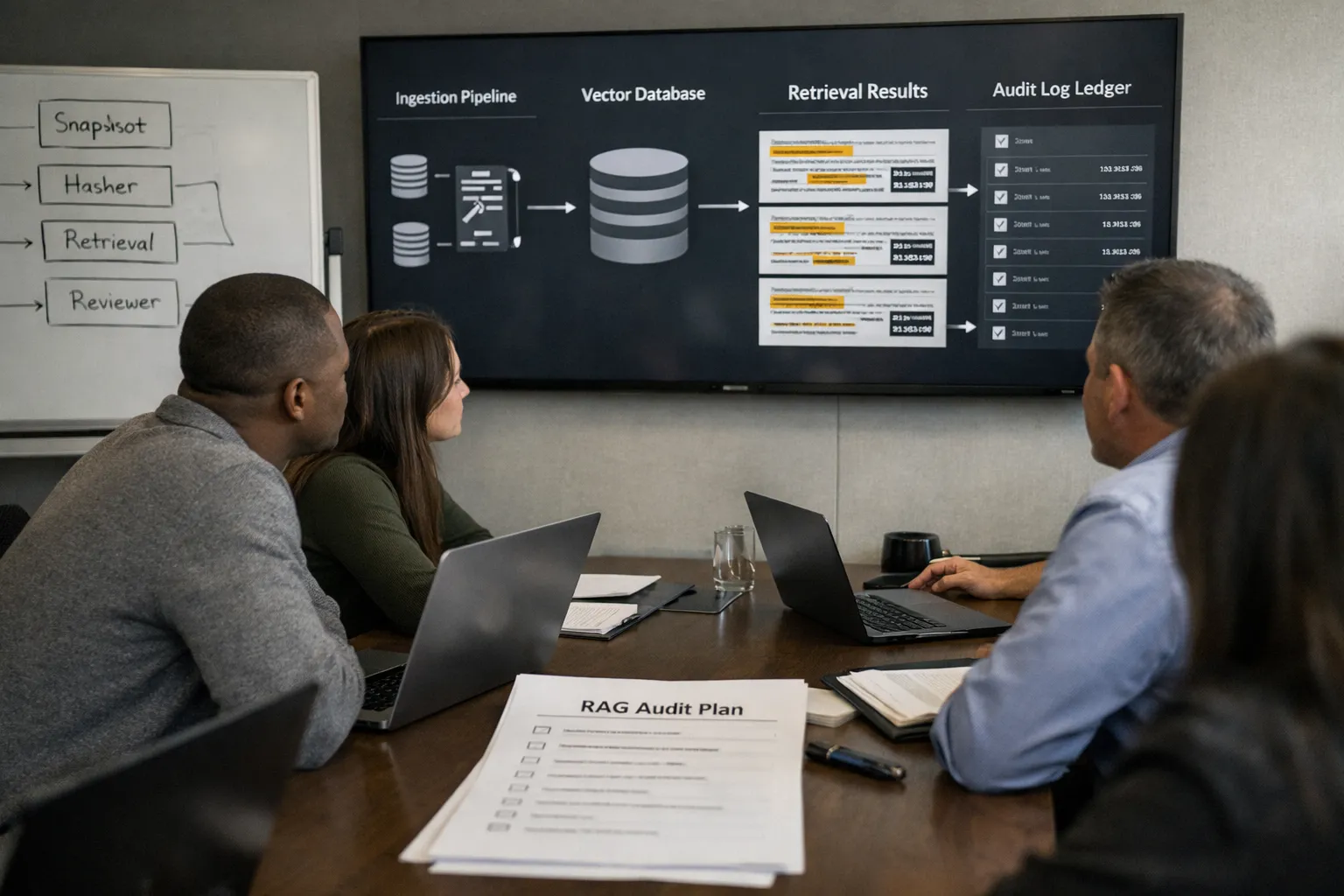
Retrieval-augmented generation (RAG) is now mainstream in enterprise knowledge tooling — and two years into broad commercial adoption the compliance bar has moved from advisory checklists to operational evidence. This August 2026 update turns the original playbook into an operational blueprint: concrete controls, new provenance tech, and testable SLOs you can show auditors today.
Who this guide is for: AI product managers, engineering leads, security/compliance teams, and AIops practitioners who must put RAG-backed knowledge services into production where answers must be auditable, reproducible, and defensible to internal auditors, external regulators, or eDiscovery requests.
Prerequisites / Context before you start
Before you build or revise a RAG pipeline for regulated or multi-tenant environments, make sure you have the following in place:
- Data governance: documented data classification and ownership for each content source (contracts, CRM, support transcripts, regulated filings, PHI/PII sets).
- Legal & privacy: signed policies for acceptable use, training exclusions, cross-border transfers, and DSAR/erasure commitments. Ensure your contracts reflect model and vendor obligations.
- Security baseline: HSM-backed signing keys, RBAC for admin actions, network segmentation for model hosts and vector stores, and endpoint hardening.
- Immutable storage and retention policy: WORM-capable buckets or ledger DBs for audit records and snapshots; documented retention tied to legal requirements (e.g., industry-specific retention ranges).
- Operational SLOs defined with stakeholders: groundedness, hallucination rate, human escalation rate, and replayability windows.
What’s new since mid-2026 (what you need to know in Aug 2026)
- Provenance tooling matured: Sigstore / Rekor-style transparency logs and signed manifests are now commonly used to publish ingestion and snapshot proofs.
- Model and embedding standardization efforts accelerated: many vendors now publish immutable model manifests (container digest, weights hash) and deterministic inference options for embeddings.
- Secure enclaves and confidential computing for inference are production-ready at scale for some providers — useful where data must never leave a regulated perimeter.
- Privacy-preserving retrieval patterns (client-side retrieval, split embeddings, and scoped search tokens) are adopted for tenant isolation and PHI use cases.
- Auditors expect replayability: it is no longer enough to log events — you must be able to replay a request against a snapshot and yield the same candidate list and structured output.
Step-by-step implementation
1. Inventory sources and classify sensitivity (do this granularly)
- Catalog every content source: document stores, wikis, email archives, CRM entries, payment ledgers, regulatory filings, and third-party knowledge bases. Record owner, retention rule, and jurisdiction per source.
- Assign field-level sensitivity tags (public, internal, confidential, regulated/PII/PHI). For regulated fields, define handling rules: block from training, retrieval-only with redaction, or allow anonymized exposures.
- Automate policy enforcement at ingestion: tag-driven pipelines should enforce redaction, tenant isolation, or denial-by-default for high-risk fields.
Why: Auditors require source-level traceability. You must be able to point to the exact file and the policy that governed its handling.
2. Canonicalize, chunk, and persist immutable metadata
- Store an immutable raw copy of each ingested file (PDF, DOCX, image). Compute canonicalized text for retrieval and keep both versions.
- Compute and persist cryptographic hashes (SHA-256) for the raw file and for each chunk. Keep original file metadata: file path, ingest timestamp, owner, and version.
- Chunk on semantic boundaries (clauses, paragraphs, sections), and attach metadata: source_id, file_version, ingestion_run_id, chunk_hash, page/byte offsets, sensitivity tags, and language.
- For images/PDFs include page number and bounding-box coordinates to support pixel-exact citations in audits or eDiscovery.
Why: Chunk-level hashes and precise coordinates are the strongest defense when you must prove "where the answer came from."
3. Pin, record, and certificate embedding models
- Pin embedding models and versions for production. Capture full provider metadata: model name, version, container digest, weights hash (if provided), and inference parameters.
- If deterministic embeddings are not available, persist provider response IDs, timestamps, and the exact API call payload. Where possible, run a local, deterministic embedding shim and verify equivalence.
- Record an ingestion manifest for each run (list of files, chunk_hashes, embedding model metadata) and sign it with your HSM; publish the manifest to a transparency log (e.g., Rekor/Sigstore) so auditors can verify it.
Why: Embedding drift is a silent source of irreproducibility. Pinning models and signing manifests makes replay and verification possible.
4. Build a versioned, auditable vector index
- Use a vector store that supports metadata per vector and full snapshot capability. If the vendor cannot provide deterministic exports, mirror vectors to your own storage and snapshot daily.
- Create a canonical index map: vector_id ↔ chunk_hash ↔ snapshot_id. Sign the mapping with your HSM and record signatures in a transparency log for tamper-evidence.
- Encrypt embeddings at rest; require RBAC for admin actions; log all admin operations to an immutable audit trail with KMS events.
Why: Indexes mutate. Signed snapshots let you demonstrate the exact index used for any historical answer.
5. Implement deterministic retrieval, hybrid matching, and preserved candidate lists
- Run hybrid retrieval (sparse + dense) and persist the full candidate list for each query (vector distances, sparse scores, chunk_hashes).
- Use a deterministic reranker (model with pinned weights or deterministic heuristic) and log reranker scores, version, and seed.
- Choose Top-K deterministically using a stable sort on (score, chunk_hash) to avoid non-deterministic tie-breaking across replays.
Why: Retrieval variability prevents replay. Persisting candidate lists and deterministic selection is required to explain outputs later.
6. Grounding, validation, and authoritative checks
- For factual claims (dates, amounts, parties), cross-check against canonical systems of record: contract ledgers, payment systems, HR records, or regulatory databases.
- Compute a composite groundedness score from retrieval, reranker, and authoritative validation results; expose this score in the structured response schema.
- For high-risk queries or low groundedness, return "insufficient evidence" and route to human review or require additional verification before downstream action.
Why: High-confidence but unsupported answers create real legal and financial risk. Make the system conservative where stakes are high.
7. Synthesize with strict templates, structured outputs, and provenance tokens
- Limit prompt context strictly to selected chunks. Pass explicit provenance tokens (source_id, chunk_hash, page offsets) alongside each chunk in the prompt context.
- Require structured, machine-readable outputs (JSON): fields should include answer, sources[], confidence, decision_path_hash, and recommended_action.
- Automatically redact or obfuscate when outputs cross tenant or clearance boundaries; include redaction metadata in the audit record.
Why: Structured outputs and embedded provenance make responses machine-auditable and legally defensible.
8. Emit immutable, signed audit records per response
- Write a single append-only audit record per request containing: query text, user/tenant ID, retrieval candidate list (chunk_hash + source_id + scores), embedding/model metadata, final prompt, structured model response, confidence, and decision flags.
- Sign each audit record with an HSM key; publish signatures to a transparency log (Sigstore/Rekor). Store records in WORM storage or ledger DB with policy-driven retention.
- Periodically compute Merkle roots of batches of records and publish them for tamper-evidence and bulk verification.
Why: Signed, tamper-evident records are now expected evidence in audits and legal discovery.
9. Human-in-the-loop, escalation automation, and reviewer trails
- Define automated risk thresholds for reviewer escalation: low groundedness, regulated topics, or potential PHI/PII exposure.
- Design reviewer UIs that present the query, retrieved chunks (with chunk_hash and offsets), model output, and links to originals. Record reviewer actions and electronic signatures in the audit trail.
- Integrate reviewer decisions into remediation workflows: mark bad chunks, flag source owners, and schedule re-ingestion where necessary.
Why: Humans remain the safety net for high-stakes decisions; their actions must be recorded and replayable.
10. Monitoring, drift detection, and controlled re-ingestion
- Track operational metrics: groundedness rate (percentage of answers with verifiable sources), hallucination regression, retrieval recall/precision vs. gold queries, embedding drift indicators, human escalation rate, and latency/cost per query.
- Alert on significant embedding cluster shifts, sudden increases in "insufficient evidence," or spikes in escalations. Maintain a timeline of ingestion and model changes mapped to alerts.
- When re-ingesting or reprocessing, snapshot indexes pre- and post-run, sign manifests, and provide replay capability for historical queries tied to snapshot IDs.
Why: Monitoring detects silent degradation. Snapshot-and-sign practices prove you maintained controls over time.
Cost and performance optimizations (practical)
- Cache signed response objects for high-frequency queries. Invalidation is driven by changes in chunk_hash or snapshot_id.
- Use tiered embeddings: high-fidelity vectors for hot content, compact quantized vectors for cold archives; document tiers in metadata.
- Batch embeddings, use bulk APIs, and for self-hosted inference run mixed-precision and GPU pooling to reduce cost.
- Precompute reranker scores for known heavy queries and use lightweight deterministic rerankers on latency-sensitive front-ends.
Testing & validation checklist
- Reproducibility: replay past queries against corresponding snapshots and confirm identical candidate lists and structured outputs.
- Audit completeness: every response emits a signed, immutable audit record and has a retrievable snapshot_id and decision_path_hash.
- Security: penetration tests against storage endpoints, KMS, and model endpoints; validate RBAC and key rotation procedures.
- Compliance: verify retention/deletion flows including proof-of-deletion for regulated records and DSAR handling.
- Escalation: simulate reviewer workflows and confirm the audit trail records reviewer IDs, timestamps, and decisions.
- Red-team factuality: periodically inject controlled misinformation into a sandboxed dataset to validate detection and escalation mechanics.
Common mistakes to avoid
- Trusting vendor immutability without independent snapshots and signatures.
- Ignoring embedding drift—failing to track model or provider changes that alter vector semantics silently.
- Returning free-text outputs without structured provenance or source links.
- Failing to sign and version prompt templates and ingestion manifests—these are part of your policy artifacts.
- Assuming a single metric (e.g., latency) measures health—groundedness and replayability matter more for audits.
Pro tips (insider moves)
- Publish your public signing key and ingestion manifest fingerprints in a transparency log for auditors to verify without needing direct access to internal systems.
- Version prompt templates with changelogs tied to deployment IDs; treat prompts as regulated artifacts and keep them auditable.
- Adopt split-retrieval for tenant isolation: perform client-side query encoding and server-side search with scoped tokens to minimize cross-tenant exposure.
- Use confidential computing for inference where regulations prohibit data export; combine with signed manifests to prove the model and environment used.
- Run quarterly replay audits: pick a sample of past queries, replay them, and produce a compliance report showing identical candidate lists and outputs.
Practical example — Contract Q&A (Aug 2026)
Situation: Legal ops needs contract answers that will be used in regulatory filings and possibly subject to eDiscovery.
- Ingest signed contracts, persisting immutable PDFs and canonical text. Compute and store chunk_hashes and page/byte offsets.
- Use a pinned embedding model (self-hosted or provider-backed with a signed manifest) and snapshot the vector index nightly to WORM storage. Sign and publish the snapshot manifest to a transparency log.
- When a lawyer queries, retrieve clauses deterministically, validate parties/dates against the contract ledger, and synthesize a JSON response with clause citations, PDF page links, and chunk_hashes.
- Append a signed audit record containing the retrieval candidate list and reviewer sign-off if the answer is used in a filing. Retain the record per legal retention policy and provide proof-of-deletion when required.
Final checklist before production
- Pinned model and embedding versions documented and signed per release.
- Chunk-level metadata and hashes persisted and searchable for audits.
- Vector index snapshots and audit logs stored in immutable, encrypted storage with policy-driven retention.
- Deterministic retrieval and reranking implemented and replayable.
- Human escalation flows and reviewer audit logs in place.
- Legal sign-off on retention, deletion, and international data flows obtained and recorded.
Why this matters now
By August 2026, the market expects not just performance but legal defensibility. Vendors will sell convenience and low latency, and some will promise "explainability" as a checkbox. But if your business relies on RAG for decisions that move money, affect customers, or touch regulated data, you need provable chains: hashes, signed manifests, snapshots, and human reviewer trails. Build with provenance-first thinking and you protect customers and your organization while still capturing the productivity gains that RAG promises.
FAQ
Do we need to self-host models to be compliant?
No. Self-hosting increases control but is not mandatory. Compliance is achievable with hosted models if you capture immutable metadata (model manifest, container/image digest), persist or mirror embeddings, and obtain contractual guarantees on data handling and model pinning. Your choice should be driven by risk assessment, cost, and legal constraints.
How long should we retain audit records?
Retention must meet the strictest applicable regulation or contractual obligation. In many regulated industries multi-year retention (commonly 3–7 years) is typical, but always document your retention policy, justify it legally, and implement automated enforcement and proof-of-deletion processes.
What operational metrics should we track for RAG health?
Track groundedness rate (percent of answers with verifiable sources), hallucination regression, retrieval recall/precision on gold queries, embedding drift indicators, human escalation rate, and latency/cost per query. Tie these to SLOs that trigger reviewer escalation and re-ingestion processes.
How do we prove an answer came from a specific document in an audit?
Persist the raw document, canonical chunk text with chunk_hash, vector snapshot_id, and the signed audit record that contains the retrieval candidate list and structured response. Use cryptographic signatures (HSM) and transparency logs so auditors can verify immutability and timeline independently.
Can we use RAG for PHI or high-risk financial decisions?
Yes—but only with strict guardrails: BAAs where required, redaction and retrieval-only rules for PHI, scoped tenant isolation, confidential computing for inference if needed, structured outputs, and mandatory human review gates before any action is taken. For high-risk decisions, require ledger-backed validation against authoritative systems prior to execution.